Tuesday, April 24, 2012

The latest Dead Man novel is out now, and it's a good one!


Freaks Must Die (Dead Man #10)


The latest Dead Man novel is out now, and it's a good one! Grab a copy!

Amazon.com: Freaks Must Die (Dead Man #10) eBook: Joel Goldman, Lee Goldberg, William Rabkin: Kindle Store: When Matt Cahill intervenes in what he thinks is a robbery, he ends up botching a ransom exchange for a kidnapped boy. His interference gets an innocent man killed and puts a child’s life in immediate jeopardy. So Matt heads to New York City, a place as foreign to him as a distant planet, to rescue the boy and make amends.

His search leads him to an underworld of “freaks,” people with uncanny powers who live in the shadows, trying to elude a dark force that’s ruthlessly hunting them down. Now Matt is in a race against time to save a child, and the entire freak community, from bloody annihilation.

I'm a big big Carole King Fan

Ed here: I'm a huge Carole King fan. What a gift this CD is.


Carole King Review: 'Legendary Demos' Honors a '60s Recording Career That Never Was

Published: April 24, 2012 @ 10:33 am
By Chris Willman

Listening to Carole King's "Legendary Demos," you enter an alternate pop universe where her stardom didn't begin with 1971's "Tapesty" but actually got under way a decade or so earlier, with King herself enjoying the spoils of her songwriting instead of giving her hits away to everybody from the Shirelles and Righteous Brothers to Aretha Franklin.

It's a fun exercise in "What if...?" -- and maybe a slightly wistful one, since "Legendary Demos" makes you feel that maybe we lost something by not having King kick off her recording career until 10 years after she'd established her writing career. She could've been a great 1960s hitmaker; the mystery is why no one forced her Jane Hancock onto a recording contract years sooner.

The collection starts with the song you might least imagine King singing -- the Monkees' hit "Pleasant Valley Sunday," the jangly sound of which never became part of her wheelhouse. (The lyrics, as with most of her early tunes, were by then-husband Gary Goffin, who was waxing sarcastic about the New Jersey suburbs King had moved them out to from Manhattan.)

For anyone who thinks "demo" will be synonymous with "girl alone at her piano," the full-band arrangement of "Pleasant Valley Sunday" comes as a pleasant surprise, and several other numbers follow suit. The most elaborate, "Like Little Children," is a full-blown pop/R&B recording with horns and female backing vocals that wouldn't give you a moment's pause if someone snuck it onto an oldies station.

Tracks that do consist of just King at her piano are just as delightful, including the earliest, a 1961 take of "Take Good Care of My Baby" (a Bobby Vee hit) that has King blueprinting the most interesting parts of the eventual arrangement with just one set of keys. On "Crying in the Rain" (a 1962 Everly Brothers smash), vocal overdubs turn King into a one-gal girl group.

The track list might initially seem slightly disappointing, if your hope is to hear King singing tunes that were only famously recorded by other artists. For instance, there's no "Will You Still Love Me Tomorrow," since, as the liner notes explain, the vocals for that particular demo were recorded by the Shirelles, not King.

Six of the 13 tracks here eventually ended up re-recorded for "Tapestry," but that doesn't make the album feel overly familiar, since some of the arrangements here are very late-'60s-period-specific. You could put her 1967 version of "(You Make Me Feel Like) A Natural Woman" up against the one she released four years later -- or, to be potentially blasphemous, against the one Aretha had a hit with that year.

And "Way Over Yonder" is indisputably better than its "Tapestry" update, since the slower, more soulful feel better reinforces that this nice Jewish girl was trying her hand at gospel.

Is it ever too late to get a terrific, newly recovered proto-version of "It's Too Late"? Not often are we graced with the equivalent of a great lost 1960s album that's finally being liberated from the vaults, which makes "Legendary Demos" a time capsule that's particularly easy to swallow.


Monday, April 23, 2012

A Free Bill Crider novel FREE on KIndle Today!


Free Today for Kindle!


The Prairie Chicken Kill (Truman Smith Mystery Series) 


Amazon.com: The Prairie Chicken Kill 
(Truman Smith Mystery Series) eBook: Bill Crider: Kindle Store


Even if you don't want to read it, please take advantage 
of the free download. Every downloaded book makes
 Amazon think better of me. Thanks!

Sunday, April 22, 2012

Noir Poets: W R Burnett

Noir Poets: W R Burnett

highsierra bogart Noir Poets: W R Burnett

“And suddenly Roy didn’t give a damn about Velma, or about Pa and Ma. He realized that they had never been real people to him at all, but figments out of a dream of the past. He began vaguely to understand that ever since the prison gate clanged shut behind him he’d been trying to return to his boyhood, where it was always summer and in the evenings the lightning-bugs flashed under the big branches of the sycamore trees and he swung on the farm gate with the yellow-haired girl from across the road while the Victrola on the porch played Dardanella. . . . Pa and Ma were replicas of his own folks merely, and Velma wasn’t really Velma, a slim, ordinary little blonde, but the ghost of Roma Stover, the yellow-haired girl swinging on the gate. . . .”

W. R. Burnett – High Sierra (1940)

http://filmsnoir.net/film_noir/noir-poets-w-r-burnett.html#ixzz1snXHRV8


Read more: http://filmsnoir.net/film_noir/noir-poets-w-r-burnett.html#ixzz1snXHRV8J
Under Creative Commons License: Attribution

Saturday, April 21, 2012

Forgotten Books: In Dubious Battle

Ed here: Given what's happening to unions ever since Ronnie came into office it's necessary to remind ourselves of how hard fought it was to create unions in the first place. And how there never would have been a sizable middle class without them. Steinbeck's novel is as angry and vital as ever.


Forgotten Books: In Dubious Battle by John Steinbeck

It's bracing to remember, in this time when mega-corporations control our lives, to recall a time when people fought back against those who enslaved them.

In Dubious Battle by John Steinbeck, a novel I prefer to the preachy and over-calculated Grapes of Wrath, is set in a tiny California town where apple pickers are angry at the growers' association for cutting wages by fifteen cents. The year is 1936 and the forces of the rich and powerful are at war with the powerless workers. Mac and Jim are the lead characters and it is Mac who takes Jim to a meeting of the Communist Party, which wants to convince the workers to strike. They are joined by Doc Burton, a medical man who keeps the worker camp clean so that the cops can't close the place down because of sanitation violations.

Steinbeck's passion can be found on every page, in every detail. The camp and its people are depicted realistically. Steinbeck is not writing a tract. Some of the workers are here just to make trouble; others are stalking horses for the Communists. Others for the growers' association. The poverty, the despair and above all the rage are palpable. As is the sorrow.

For me Jim is the most interesting character in the book because he changes over the course of his experiences. He begins to see that the concept of "the working man's friend" is a lie. The Communists exploit the workers just as the Capitalists do. Doc has his vision of how things should be; Mac believes in political movements; but Jim finds no comfort. The misery he has seen in his years seems a brutal and irrefutable fact of life.

Steinbeck was long ago judged as second-tier to his enemy Hemingway. I never quite knew why. Good as he was, Hemingway could not have painted on a canvas this large and done it with such grace and power. You'll never forget the people you meet here.

Friday, April 20, 2012

I Will Not Read Your Fucking Script

Thursday, April 19, 2012

Forgotten Books: The Great American Paperback by Richard Lupoff

AAmazon.com Review

Penzler Pick, October 2001: There may be some irony in the notion that a book devoted to paperbacks (the most inexpensive book format--small, easily transportable and disposable) is a huge, expensive, beautifully produced hardcover volume that is certain to be a gem in any collector's library.

For several centuries books in America customarily were pages bound between hardcovers and, in this century, had dust jackets wrapped around them, initially just to protect the cloth covers, but eventually as an attention-grabbing advertising poster.

In 1938, an experiment was launched. The cloth cover was exchanged for a paper one, and the colorful illustration and information that appeared on the dust jacket (author, title, publisher, a few lines about the book) was printed directly onto those paper covers. Cheaper paper was used, since these artifacts were no longer expected to form part of a permanent library, but were to be as disposable as a newspaper or magazine. And they were cheap: a 25-cent price made books affordable for a huge portion of the population. They became immeasurably successful almost overnight.

Today many of those books are highly sought-after collectors' items. In spite of the huge numbers printed, they are scarce now simply because almost no one ever thought to save them in colorful, pristine condition. The Great American Paperback illustrates in glorious full color more than 600 of the most interesting and collectable paperbacks, each with an informative caption that provides as much fascinating anecdotal information as the text, which is a masterly and scholarly history of the American paperback, tracing its roots to the early 19th century and concluding with a look at the future.

There are samples of the paperback originals of Ed McBain, Richard Stark, Jim Thompson, Harlan Ellison, and James M. Cain, as well as illustrations of such rarities asThe Maltese Falcon, which was issued as a paperback with a dust jacket, and Ellery Queen's Halfway House, which was offered in two formats by the publisher, one bound the usual way, the other bound at the top edge.

If this massive work hadn't been produced in Hong Kong, it would have cost twice as much and is, believe it or not, a bargain, even at a price as hefty as the book itself. --Otto Penzler


Ed here: Dick Lupoff has distinguished himself as a writer of both mystery and science fiction and fantasy. He has also been and editor and biographer of great renown. I first heard of him when he and his lovely wife Pat began publishing the legendary science fiction/comic book XERO back in the early 1960s. If you'd like to know (or remember) what genre fiction as all about in that lost age I suggest you but the hardbound collection of XERO's including Donald E.Westlake's scorching goodbye to his science fiction career.

But this magnificent history--because it's nothing less--of paperbacks books in America would be enough to make you well known and respected. The covers are knock-outs and the text is packed with stories and tales of writers and editors and publishers are told with Dick's usual wit, high style and erudition.

There are many books about paperbacks but I can't think of any that come even close to this sprawling, hilarious, melancholy, fact-packed tribute to the highs and lows of American publishing.

This is a singular accomplishment and Dick Lupoff should be honored for it.


Wednesday, April 18, 2012

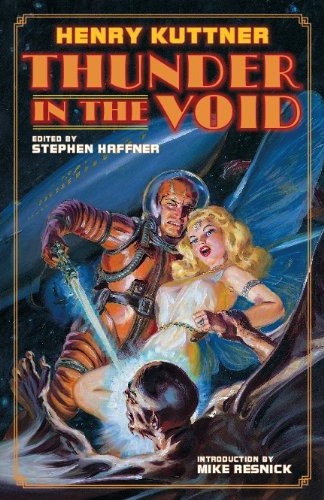
Henry Kuttner: Thunder In The Void


My favorite pulp writer in a beautifully made collection

Ed here: Haffner Press scores again. This is not an exaggeration. As soon as I got this book I opened it at random and was so quickly drawn into the story that I sat down and read the whole thing on the spot. This is a must-have book for pulp fans and collectors alike. And I should mention the fine introduction by the great Mike Resnick, too.
Go here for the website: http://www.haffnerpress.com/Thunder in the VoidHenry Kuttner

Introduction by Mike Resnick

Cover Art by Norman Saunders

ISBN-13 9781893887534

600+ pp. Hardcover$40.00

Prior to his marriage to fellow science-fantasy writer Catherine L. Moore in 1940, Henry Kuttner wrote stories of Lovecraftian horror, weird-menace “shudder” tales, and thrilling adventure stories. But he also wrote blood-n-thunder Space Opera stories in the vein of Edmond Hamilton (one of young Kuttner’s favorite authors) told with a rough-edge style similar to Kuttner’s protege Leigh Brackett.THUNDER IN THE VOID is a massive collection of 16 vintage Space Opera stories selected from classic pulp magazines such as Weird Tales, Marvel Science Stories, Astonishing Stories, Super Science Stories, Super-Detective, and of course, Planet Stories. Most of the these are appearing in book form for the first time. An added bonus, Haffner Press is pleased to include anunpublished story by Kuttner, “The Interplanetary Limited.”Award-winning author (and the only writer to stage a live performance of a Kuttner Space Opera story) Mike Resnick contributes an introduction reflecting on his admiration for stories by Kuttner (and Moore).


TABLE of Contents

Raider of the Spaceways (Weird Tales, Jul ’37)Avengers of Space (Marvel Science Stories, Aug ’38)The Time-Trap (Marvel Science Stories, Nov ’38)
*The Lifestone (Astonishing Stories, Feb ’40)
*Monsters of the Atom (Super-Detective, Apr ’41)
*Red Gem of Mercury (Super Science Stories, Nov ’41)
*The Crystal Circe (Astonishing Stories, Jun ’42)
*War-Gods of the Void (Planet Stories, Fll ’42)
*Thunder in the Void (Astonishing Stories, Oct ’42)
We Guard the Black Planet (Super Science Stories, Nov ’42)
*Soldiers of Space (Astonishing Stories, Feb ’43)
*Crypt-City of the Deathless One (Planet Stories, Win ’43)
The Eyes of Thar (Planet Stories, Fll ”43)
What Hath Me (Planet Stories, Spr ’46)
*Carry Me Home (Planet Stories, ’50)
The Interplanetary Limited (first time in print)oduction by Mike Resnick
*Raider of the Spaceways (Weird Tales, Jul ’37)
Avengers of Space (Marvel Science Stories, Aug ’38)
The Time-Trap (Marvel Science Stories, Nov ’38)
*The Lifestone (Astonishing Stories, Feb ’40)
*Monsters of the Atom (Super-Detective, Apr ’41)
*Red Gem of Mercury (Super Science Stories, Nov ’41)
*The Crystal Circe (Astonishing Stories, Jun ’42)
*War-Gods of the Void (Planet Stories, Fll ’42)
*Thunder in the Void (Astonishing Stories, Oct ’42)
We Guard the Black Planet (Super Science Stories, Nov ’42)
*Soldiers of Space (Astonishing Stories, Feb ’43)
*Crypt-City of the Deathless One (Planet Stories, Win ’43)
The Eyes of Thar (Planet Stories, Fll ”43)
What Hath Me (Planet Stories, Spr ’46)
*Carry Me Home (Planet Stories, ’50)
The Interplanetary Limited (first time in print)

Perry Mason DVD; New York Times

SATURDAY, DECEMBER 30, 2006

Perry Mason DVD; New York Times

The Case of the Canny Counsel


Article Tools Sponsored By
By ADAM LIPTAK
Published: December 31, 2006

IN memory the old “Perry Mason” was campy and obvious. At the end of each hour Raymond Burr would rise commandingly from his courtroom chair and, with just a question or two and perhaps a peeved glare, elicit a detailed and tearful confession from a witness with more aptitude for murder than for perjury.

Those Perry Mason moments are as awkward and unrewarding today as they were in 1957, when CBS began broadcasting the series. But almost everything else about the show is splendid, and the 39 episodes from the first season recently released on DVD are a box of L.A. noir chocolates, well constructed and satisfyingly dark.

They start with that swaggering theme music, by Fred Steiner, and some irresistible episode titles (“The Case of the Cautious Coquette,” “The Case of the Restless Redhead,” “The Case of the Vagabond Vixen,” “The Case of the Lazy Lover”). The setups are brisk and racy, usually involving an attractive young woman, the suggestion of ill-considered intimacy and, in short order, a corpse.

Beautifully filmed in black and white, the shows have become period dramas over time, stuffed with relentless smoking, skinny ties, hard-to-get divorces, propeller planes and the threat of the gas chamber. All this was just scenery at the time, but it has now imbued the show with a real sense of place, of a California draped in shadows and suffused with gaudy ambition and sexual jealousy.

“Perry Mason” was also, week in and week out, a well-made television show, the work of professionals. It moves a little slowly for modern tastes, but it was precisely constructed, sophisticated and intricate enough to reward careful attention.

For the rest of the article log on here:
http://www.nytimes.com/2006/12/31/arts/television/31lipt.html?ref=arts

Ed here:

Owing to various hospital stays over the past five years, I've logged a lot of hours watching the Perry Masons referred to here. This Litvak review is excellent. And I certainly agree with it. Most of the hokum comes at the end when the light bulb appears above Perry's head and sometimes in the somewhat strained dialogue between Perry and Della and Paul Drake, which sometimes sounds like three people on morning TV making chirping sounds at each other.

What struck me most about the shows was how adult and seedy they are. A lot of the seediness is between the lines but boy is it there. As I mentioned here last week writing about the early Mason novels (those still influenced by Black Mask), the stories are packed with sex and the villains are frequently business men. You could be forgiven for thinking you're reading Upton Sinclair or Sinclair Lewis in sections of the early Masons. He sure didn't trust trust big business and he he had an almost socialistic scorn for the greed success inspires (I watched Treasure of Sierra Madre earlier today--a pure straight shot of B. Traven's rage was something Gardner would likely have understood).

Litvak's best point is that the early Mason TVs have become historical dramas. They are one of the most accurate depicitions of the Fifties I've ever seen. Lordy the fetishes we made of our clothes, cars, home furnishings. And the way we looked at poor people--rarely to be trusted, rarely able to speak with any clarity, lost in booze or self-pity or just plain despicable laziness. The Lonely crowd, The Man in The Grey Flannel Suit, The Status Seekers--some of the observations in the Masons are as acute as these bestsellers of the Fifties. There's a whole book waiting to be read on the sopciology of the first three or four Mason years--not that I'd read it, you understand. But it's mildly interesting to think about up there on my Unread shelf.

My favorite pulp writer in a beautifully made collection

TitV

Ed here: This is not an exaggeration. As soon as I got this book I opened it at random and was so quickly drawn into the story that I sat down and read the whole thing on the spot. This is a must-have book for pulp fans and collectors alike. And I should mention the fine introduction by the great Mike Resnick, too.


Go here for the website: http://www.haffnerpress.com/

Thunder in the Void

Introduction by Mike Resnick
Cover Art by

ISBN-13 9781893887534
600+ pp. Hardcover

$40.00

Prior to his marriage to fellow science-fantasy writer Catherine L. Moore in 1940, Henry Kuttner wrote stories of Lovecraftian horror, weird-menace “shudder” tales, and thrilling adventure stories. But he also wrote blood-n-thunder Space Opera stories in the vein of Edmond Hamilton (one of young Kuttner’s favorite authors) told with a rough-edge style similar to Kuttner’s protege Leigh Brackett.

THUNDER IN THE VOID is a massive collection of 16 vintage Space Opera stories selected from classic pulp magazines such as Weird Tales, Marvel Science Stories, Astonishing Stories, Super Science Stories, Super-Detective, and of course, Planet Stories. Most of the these are appearing in book form for the first time. An added bonus, Haffner Press is pleased to include anunpublished story by Kuttner, “The Interplanetary Limited.”

Award-winning author (and the only writer to stage a live performance of a Kuttner Space Opera story) Mike Resnick contributes an introduction reflecting on his admiration for stories by Kuttner (and Moore).

TABLETable of Co

Raider of the Spaceways (Weird Tales, Jul ’37)

Avengers of Space (Marvel Science Stories, Aug ’38)

The Time-Trap (Marvel Science Stories, Nov ’38)
*The Lifestone
(Astonishing Stories, Feb ’40)
*Monsters of the Atom
(Super-Detective, Apr ’41)
*Red Gem of Mercury
(Super Science Stories, Nov ’41)
*The Crystal Circe
(Astonishing Stories, Jun ’42)
*War-Gods of the Void
(Planet Stories, Fll ’42)
*Thunder in the Void
(Astonishing Stories, Oct ’42)
We Guard the Black Planet
(Super Science Stories, Nov ’42)
*Soldiers of Space
(Astonishing Stories, Feb ’43)
*Crypt-City of the Deathless One
(Planet Stories, Win ’43)
The Eyes of Thar
(Planet Stories, Fll ”43)
What Hath Me
(Planet Stories, Spr ’46)
*Carry Me Home
(Planet Stories, ’50)

The Interplanetary Limited (first time in print)oduction by Mike Resnick
*Raider of the Spaceways (Weird Tales, Jul ’37)
Avengers of Space
(Marvel Science Stories, Aug ’38)
The Time-Trap
(Marvel Science Stories, Nov ’38)
*The Lifestone
(Astonishing Stories, Feb ’40)
*Monsters of the Atom
(Super-Detective, Apr ’41)
*Red Gem of Mercury
(Super Science Stories, Nov ’41)
*The Crystal Circe
(Astonishing Stories, Jun ’42)
*War-Gods of the Void
(Planet Stories, Fll ’42)
*Thunder in the Void
(Astonishing Stories, Oct ’42)
We Guard the Black Planet
(Super Science Stories, Nov ’42)
*Soldiers of Space
(Astonishing Stories, Feb ’43)
*Crypt-City of the Deathless One
(Planet Stories, Win ’43)
The Eyes of Thar
(Planet Stories, Fll ”43)
What Hath Me
(Planet Stories, Spr ’46)
*Carry Me Home
(Planet Stories, ’50)
The Interplanetary Limited (first time in print)