Friday, March 23, 2012

Blood On The Mink; Texas Wind


Excuse me while I back into this review.

By my strictly scientific calculation I first read Robert Silverberg in late 1955 or early 1956. In those days I was eagerly buying all four of the science fiction magazines aimed at deranged adolescents who preferred Bug Eye Monsters and Brass Bra'd Beauties to reality.

Amazing and Fantastic from Ziff-Davis and Imagination and Imaginative Tales from Bill Hamling, these were my mainstays. The latter, especially its short lead "novels," were, as I recall slightly more sophisticated than the stories in the Ziff-Davis books. But probably not by much.

Silverberg and his sometime collaborator Randall Garrett were everywhere in sf under various names. From the slam-bang action of the aforementioned mags to the more sophisticated Astounding and (to me the best of them all) the wry prescient Galaxy. And as we now know Silverberg was also writing for men's magazines and numerous Manhunt imitators. Plus many other markets even Silverberg may not remember. In 1959 or so he began writing one or two or three soft core novels a month. You know in his spare time.

Even in his action adventure mode his sf often showed an intelligence and a humanity not found in the work of his competitors. He was fascinated by political systems and their effects on people and used his tales to extrapolate and demonstrate where some our of contemporary systems were headed.

As early as 1959 his work started to foreshadow the genius (yes, genius) that was to appear full born in the Sixties. The genius that survives today.

I mention all this to salute one of the great writers of our time and to give you a sense of how excited I was to get my hands on a copy of Blood On The MInk, Silverberg's magazine novel written for TRAPPED, another faux Manhunt mag that went out of business just before it was to publish Mink.

It was well worth the wait. The short novel plus the two short stories round out a collection that has the energy of an assault. The two main tropes in Mink very much reflect the times--stories about undercover agents were popular as were agents who posed as other people. (Harry Whittington must have done four or five of them.) Both tropes were frequently seen on TV. But Silverberg's storytelling powers make both of them his own.

I've always imagined that Silverberg was a quick study when surveying a given market. Mink has everything--va-voom blondes, sadistic thugs, plot twists every ten pages and ample supplies of sex and violence--plus actual suspense. You really do wonder where our undercover Federal Agent is taking us. He's trying to to break up a counterfeit ring by locating not only the exquisite plates but also the man who made them.

As with his action sf there is a hard intelligence working here. His contrast of bad queer money and good queer money is fascinating as is the means through which such money is put into the system. His knowledge lends the story a realism it wouldn't have otherwise.

You'll have a great time with this. For duffers it'll bring back the real Fifties perfectly. And for readers of every age it'll be a great good time.

-----------------------------TEXAS WIND

We all have books we go back to several times over the years. For me one of the finest private eye novels I've ever read is Texas Wind by James Reasoner. It is a virtually perfect utterance, a story of a man, an era and a place.

While the set-up is familiar, "a missing daughter job" as Hammett once began a story of his, the op here, named Cody, gives us a Texas I'd never seen before and a private eye who might be the guy you have coffee with at the donut shop counter a couple days a week. The reality is what makes the dark surprises of the book stay real. A real person is telling you the story.

Texas is too often writ so large it becomes comic without meaning to be. James' social observations are worth the price alone. My favorite is a scene where Cody, a Southerner, wonders about a man because he's a Northerner. I've seen this written so many times by Yankees that it was a jolt realizing that it cuts both ways. I loved it.

Filled with exciting incident and humane observation, Texas Wind is one of those books that should be read by everyone who wants to write a mystery novel. This will show you how.

Livia Washburn, James' talented and lovely writer wife, is also a talented and lovely artist. Who knew? Here's her new cover for Texas Wind.


New Cover for Texas Wind

Thursday, March 22, 2012

Forgotten Books: Richard Neely

Forgotten Books: The Plastic Nightmare


Richard Neely wrote non-series crime novels that pretty much covered the entire range of dark suspense. I mentioned that in the best of them the weapon of choice is not poison, bullets or garrote. He always prefered sexual betrayl.

Plastic is a good example. Using amnesia as the central device ,Dan Mariotte must reconstruct his life. Learning that the beautiful woman at his bedside all these months in the hospital--his wife--may have tried to kill him in a car accident is only the first of many surprises shared by Mariotte and the reader alike.

What gives the novel grit is Neely's take on the privileged class. He frequently wrote about very successful men (he was a very successful adverts man himself) and their women. The time was the Seventies. Private clubs, privte planes, private lives. But for all the sparkle of their lives there was in Neely's people a despair that could only be assauged (briefly) by sex. Preferably illicit sex. Betrayl sex. Men betrayed women and women betrayed men. It was Jackie Collins only for real.

Plastic is a snapshot of a certain period, the Seventies when the Fortune 500 dudes wore sideburns and faux hippie clothes and flashed the peace sign almost as often as they flashed their American Express Gold cards. Johny Carson hipsters. The counter culture co-opted by the pigs.

The end is a stunner, which is why I can say little about the plot. Neely knew what he was doing. Watching him work was always a pleasure.

Blood on The Mink; Texas Wind


Excuse me while I back into this review.

By my strictly scientific calculation I first read Robert Silverberg in late 1955 or early 1956. In those days I was eagerly buying all four of the science fiction magazines aimed at deranged adolescents who preferred Bug Eye Monsters and Brass Bra'd Beauties to reality.

Amazing and Fantastic from Ziff-Davis and Imagination and Imaginative Tales from Bill Hamling, these were my mainstays. The latter, especially its short lead "novels," were, as I recall slightly more sophisticated than the stories in the Ziff-Davis books. But probably not by much.

Silverberg and his sometime collaborator Randall Garrett were everywhere in sf under various names. From the slam-bang action of the aforementioned mags to the more sophisticated Astounding and (to me the best of them all) the wry prescient Galaxy. And as we now know Silverberg was also writing for men's magazines and numerous Manhunt imitators. Plus many other markets even Silverberg may not remember. In 1959 or so he began writing one or two or three soft core novels a month. You know in his spare time.

Even in his action adventure mode his sf often showed an intelligence and a humanity not found in the work of his competitors. He was fascinated by political systems and their effects on people and used his tales to extrapolate and demonstrate where some our of contemporary systems were headed.

As early as 1959 his work started to foreshadow the genius (yes, genius) that was to appear full born in the Sixties. The genius that survives today.

I mention all this to salute one of the great writers of our time and to give you a sense of how excited I was to get my hands on a copy of Blood On The MInk, Silverberg's magazine novel written for TRAPPED, another faux Manhunt mag that went out of business just before it was to publish Mink.

It was well worth the wait. The short novel plus the two short stories round out a collection that has the energy of an assault. The two main tropes in Mink very much reflect the times--stories about undercover agents were popular as were agents who posed as other people. (Harry Whittington must have done four or five of them.) Both tropes were frequently seen on TV. But Silverberg's storytelling powers make both of them his own.

I've always imagined that Silverberg was a quick study when surveying a given market. Mink has everything--va-voom blondes, sadistic thugs, plot twists every ten pages and ample supplies of sex and violence--plus actual suspense. You really do wonder where our undercover Federal Agent is taking us. He's trying to to break up a counterfeit ring by locating not only the exquisite plates but also the man who made them.

As with his action sf there is a hard intelligence working here. His contrast of bad queer money and good queer money is fascinating as is the means through which such money is put into the system. His knowledge lends the story a realism it wouldn't have otherwise.

You'll have a great time with this. For duffers it'll bring back the real Fifties perfectly. And for readers of every age it'll be a great good time.

-----------------------------TEXAS WIND

We all have books we go back to several times over the years. For me one of the finest private eye novels I've ever read is Texas Wind by James Reasoner. It is a virtually perfect utterance, a story of a man, an era and a place.

While the set-up is familiar, "a missing daughter job" as Hammett once began a story of his, the op here, named Cody, gives us a Texas I'd never seen before and a private eye who might be the guy you have coffee with at the donut shop counter a couple days a week. The reality is what makes the dark surprises of the book stay real. A real person is telling you the story.

Texas is too often writ so large it becomes comic without meaning to be. James' social observations are worth the price alone. My favorite is a scene where Cody, a Southerner, wonders about a man because he's a Northerner. I've seen this written so many times by Yankees that it was a jolt realizing that it cuts both ways. I loved it.

Filled with exciting incident and humane observation, Texas Wind is one of those books that should be read by everyone who wants to write a mystery novel. This will show you how.

Livia Washburn, James' talented and lovely writer wife, is also a talented and lovely artist. Who knew? Here's her new cover for Texas Wind.


New Cover for Texas Wind

Wednesday, March 21, 2012

Michael Dirda- Edgar Rice Burroughs


MONDAY, MAR 12, 2012 7:00 PM CDT (from Salom)
The unlikely creator of John Carter

Long before the Disney movie, a failed light bulb salesman began writing stories of Mars warriors and ape men
BY MICHAEL DIRDA, BARNES & NOBLE REVIEW

TOPICS:BOOKS

This article appears courtesy of The Barnes & Noble Review.

In 1911, Edgar Rice Burroughs, having failed at everything else, decided to write a novel. He was then in his mid-30s, married with two children, barely supporting his family as the agent for a pencil-sharpener business. In earlier years he’d served in the Seventh Cavalry, worked as a rancher and gold miner, started an advertising agency, sold light bulbs and candy and uplifting books door-to-door, and not really made a go of anything.

For occasional entertainment Burroughs read the early pulp magazines, especially All-Story. Named after the cheap newsprint upon which they were printed, the pulps supplied adventure and romantic fiction to the masses for half a century. By the 1920s and ’30s newsstands around the country would display the lurid and spicy covers of Weird Tales, the Shadow, Amazing Stories, True Confessions, Dime Detective, Astounding, and Black Mask. Pulp writers would include such important literary figures as H. P. Lovecraft, Robert E. Howard, Dashiell Hammett, Raymond Chandler, Robert A. Heinlein and scores of others.

But in 1911 most of the writers weren’t of this caliber, and Burroughs was convinced he could write better adventure stories and maybe even make a living at it.

In fact he rather underestimated himself.

One hundred years ago, in the February 1912 issue of All-Story, there appeared the first installment of “Under the Moons of Mars” (retitled “A Princess of Mars” for its 1917 book publication). It starts, as all good adventure stories should, with a strange manuscript, this one a memoir penned by Captain John Carter and bequeathed to his nephew Edgar Rice Burroughs. The reader is hooked from the very first sentence: “I am a very old man now; how old I do not know.” Over the next several months purchasers of All-Story would learn of the fantastic adventures of this former Confederate soldier. Mysteriously transported to Mars, called Barsoom by its inhabitants, John Carter there battled monstrous beasts and warlike peoples, soon falling in love with the copper-skinned Deja Thoris, Princess of Helium.

The serial, needless to say, was a hit, though no one yet knew that ERB would soon become a phenomenon. His editor at All-Story quickly asked him to write a historical novel, which the obliging author produced in a few weeks, only to have the chivalric romance rejected. Eventually, it would be revised and rejected again. Putting “The Outlaw of Torn” aside, Burroughs took up his own new idea, its action set largely in Africa (where he had never been). Drawing on the classical legends of the heroic Romulus and Remus, who were suckled by a wolf, and adding a touch of Mowgli from Kipling’s “The Jungle Books,” Burroughs created one of the most famous fictional characters of modern times. In the November, 1912 issue of All-Story — only a few months after the conclusion of John Carter’s adventures on Mars — there appeared, published in its entirety, “Tarzan of the Apes.”

Readers went crazy.


For the rest go here: http://www.salon.com/2012/03/13/the_unlikely_creator_of_john_carter/

Tuesday, March 20, 2012

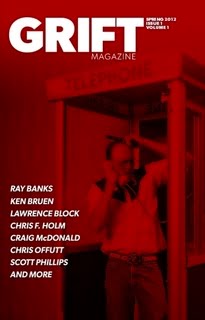
NEW & EXCITING GRIFT MAGAZINE


ORDER HERE: http://www.lulu.com/shop/john-kenyon/grift-no-1/paperback/product-20005345.html
List Price: $9.00
Price: $7.65
You Save: $1.35 ( 15% )
Ships in 3-5 business days

A new crime fiction journal that mixes interesting, hard-hitting non-fiction with some of the best short fiction in the genre.
The lineup is:

Scott Phillips on the Factory novels of Derek Raymond
Ray Banks on film adaptations of Charles Willeford’s books
Lawrence Block on his various experiments with storytelling styles
Chris Rhatigan’s long interview with author Julie Morrigan
John Kenyon's interview with author Chris Offutt
John Kenyon's review of the three novels of John Rector

It also features brand new crime fiction stories from Jack Bates, Ken Bruen, Alec Cizak, Matthew C. Funk, Chris F. Holm, Craig McDonald, Court Merrigan, Thomas Pluck, Keith Rawson and Todd Robinson.

INTERVIEW WITH GRIFT PUBLISHER JOHN KENYON

An interview with Grift Publisher John Kenyon:

1. You've spent most of your adult life as a reporter. Did any of your experiences lead you to hardboiled crime fiction?

Unlike some who have emerged from this job with a notebook full of ideas, I suppose I was driven to write about crime at least in part because of a lack of it in my day job. Of course, I have covered almost everything but cops and courts in my career, so it's no surprise that I didn't write much about crime. Really, I'm sure my motivation to turn to fiction was much like that of most people who earn a living writing news: Forced all day to stay within the confines of truth and facts (regardless of what those clever wags always so quick to criticize the media may suggest), it's nice to go home and spin out a tale made up of whole cloth. Sure, I'll pull bits and pieces from things I've reported on -- the novel I'm working to polish draws on the most newsworthy event to hit our area in 50 years -- but only in bits and pieces. I've yet to be so influenced by something on the beat that I've had the desire to fictionalize it.

2. How did the idea Grift develop?

There seems to have been an explosion of outlets for crime fiction over the past five years or so. Thanks to the ease of starting a sophisticated web site or utilizing print-on-demand technology, several people have launched publications of one kind or another. I've long had it in my head that I wanted to do something like this myself. The boxes in my basement full of issues of a music 'zine I published in the 90s (back issues available cheap!) kept me from taking that leap. The above-mentioned developments render that worry moot; Grift is print-on-demand, which means no inventory, no overhead. With that out of the way, I decided to do this. That said, I wouldn't have done so if I didn't think Grift would offer something different. I love Needle and Pulp Modern and other new-ish crime fiction magazines. But they are fiction-only. I wanted something that blended fiction and non-fiction.

There are outlets that do offer that mix; Crime Factory does it best. But I believe Grift is different from these, as much in tone as anything else. As I say in the submission guidelines, "Avoid things on either end of the intensity spectrum: we are not interested in cozies, nor are we impressed with stories drenched in buckets of blood with high body counts. Make us think, challenge us; it’s not the size of the gun, it’s what you do with it." I think this issue bears that out. There is a place for the ultra-violence of the so-called psycho-noirs -- and I read and enjoy it when it's done well -- I just don't want to publish it. Selfishly, I wanted to make the magazine that I want to read. I accomplished that. I hope enough other people share my sensibilities to make it a worthwhile endeavor.

3. The table of contents appear above. As I've said to you privately this is the most ambitious and extraordinary first issue of any kind I've ever seen. Was gathering all this material as daunting a job as I'd guess?

Thank you, Ed. That is high praise coming from you. It wasn't as daunting as one might expect. At my web site, Things I'd Rather Be Doing, I have interviewed and become friendly with many crime fiction writers over the years. After deciding to do this, I made a list of the people I knew that I wanted in this magazine. About half of them are in this first issue, and others have said that when they have something they think would fit, they'll submit it. The crime fiction community is full of nice, encouraging, supportive people who were willing to trust me with their work, despite having seen nothing more than a slick-looking web site. My hope is that their faith is justified by the final product, and that they and others will be willing to contribute in the future as a result.

4. What was your biggest obstacle in putting the issue to bed?

Time. A busy day job, two young kids full of energy, my own writing and reading... my romantic notions of chipping away at this in my free time quickly gave way to the reality that I would need to approach it like a part-time job. Now that I know the demands of getting an issue out, I hope to moderate that some, but I'm aware that to do this right, I'll need to dedicate significant time to it.

5. Since every magazine supposedly has a mission what do you see Grift's as being?

In short, to offer a good read. As I said above, I want this to offer a mix of insightful non-fiction and the best short fiction available. If someone reads the entire thing and wants more, I'll be happy. If they read something here and go in search of more from the people who contributed, I'll be ecstatic. I also want it to look great, and I'd be remiss if I didn't give a lot of credit to the designer, Tod Foley. He's an old friend who worked with me on that old music 'zine. We've both gotten a lot better since, and I'm excited for people to see the result.

6. What comes next for Grift?

If I'm able to manage it time-wise, we'll have two more issues in 2012, settling into a thrice-yearly schedule. I'd love to see more submissions on the non-fiction side of things. All but one non-fiction piece in this issue was solicited. They're great, and I think it makes for a nice blend, but the magazine will get stale quickly if the contents are limited to what I can conceive. I want long-form, New York Review of Books-style reviews that take an author's entire body of work into consideration when weighing a new work. I want essays that look at various eras, or sub-genres, or settings. I want probing interviews. I also would like to see more diversity in contributors. Save for interview subject Julie Morrigan, this is a magazine by and about white guys, mostly between the ages of 30-50. The big reason for that is that I received only one submission from a woman, and that one I hope to run in a subsequent issue. My hope is that once people see the magazine and what it offers, it will spark ideas and lead to a greater number of submissions.

Monday, March 19, 2012

The Mob In The Music & Night Club Business


Ed here: This runs maybe seven thousand words. Thanks to my friend Marty Greenberg I got interested in the history of show business. This article deals with some of its most sordid and violent times. It's worth a glimpse anyway. Mark Evanier soffered a link to it on his blog..

Mobsters, Scoundrels, Comedians and Rat Finks by Kliph Nesteroff

"The record business in those days was Mob controlled. It wasn't a fun business to be in." - Dick Curtis, Comedian

"A lot of people didn't like [comedian] Jackie Kannon. They didn't like his toughness." - Sol Weinstein, Gagwriter

"Then there was Morris Levy's endless supply of special girlfriends and his passion for gambling and prostitutes." - Tommy James, Lead Singer of The Shondells

The Mob ran the record biz. During the height of America's nightclub abundancy, the ruthless owner of New York's Birdland and Peppermint Lounge was one of the most powerful men in the scene. Morris Levy used his clubs to promote the acts on his record label and he used his record label to exploit his clubs. Immersed in these two worlds, it was natural that Morris Levy would encounter every stand-up comedian in the business.

As television became common in the early nineteen fifties, the majority of radio programming moved to the visual terrain. The scramble to fill radio's dead air gave birth to the disc jockey and the pop music hustle. Morris Levy ensured that his label, Roulette Records, was there to fill the void. Radio became pop music's round-the-clock infomercial, dictating which tracks would sell in record stores. Morris Levy was a master at ensuring his artists got airplay. That mastery involved a faculty of full-time thugs and their impressive collection of bedraggled baseball bats.

Joey Dee and The Starlighters were one of Levy's most profitable acts. "I'd get in the limo with George Goldner, an employee," says Joey. "He'd drive. It would be a couple ladies of the evening, hookers, in the back of the limo and we'd drive to these towns. They'd meet with the deejays, give them an envelope with cash in it, allow them their way with the girls in the car, and then go on to the next town. And the next town. And the next town. Our records were played. God forbid they took the money and didn't play the records. That's when the baseball bats came out... and worse."

Between 1960 and 1966 the biggest fad going in the LP world was comedy records. Labels big or small, comedians hopelessly funny or just downright hopeless, pressed albums. Levy thought nothing of giving a disc jockey an envelope full of cash and yet, he denied his recording artists the same courtesy. Major acts like Buddy Knox or Jimmie Rodgers found themselves nearly broke while their names were at the top of the charts. The Roulette comedians didn't fare any better. Unlike the musicians that signed a slanted contract, Roulette's comedians had no contract at all. Many had their act recorded clandestinely - and released to the market without permission. Any other record label would have faced a major lawsuit. Roulette Records was different. You got a problem with us? That's fine. Soon you're gonna have a problem with your legs.

For the rest go here:http://blog.wfmu.org/freeform/2012/03/mobsters-rat-finks.html

Sunday, March 18, 2012

The Tragedy of Kevin Sorbo from Salon


Ed here: I always thought Sorbo was a pretty good B actor. I'm posting this because it's emblematic of how tough it is tob e an actor.

The tragedy of Kevin Sorbo
With a new straight-to-DVD offering, the "Hercules" star sinks to sad new lows VIDEO
BY BOB CALHOUN

Kevin Sorbo in "Tales of an Ancient Empire"

TOPICS:STRAIGHT TO DVD
Movie reviewers will often say that a film is “painful to watch.” It’s an expression that gets thrown around quite liberally, but it’s actually very rare that a film is so incompetent that it might set off intracranial bleeding. “Tales of an Ancient Empire” is just such a film, and much of its ability to do irreparable damage comes from its near total lack of medium shots and wide angle shots.

And what’s even more of a bummer is that I’ve been looking forward to this thing since I first saw “The Sword and the Sorcerer” when I was 13 years old. “Sword and the Sorcerer” had just about everything an adolescent nerd could want from R-rated fantasy flicks: disgusting demons that made peoples’ heads explode, lots of bare breasts, a wicked sword that launched its blades like a hazardous toy, and a barbarian mercenary named Talon (Lee Horsley of TV’s “Matt Huston”) leading an army of swashbuckling johns recruited from a brothel to save a kingdom. In short, it was the best awful sword and sorcery film ever, and it even displayed generally competent filmmaking. But its end credits also promised that Talon would return in “Tales of Ancient Empire.” He never did. My teenage years were ruined.

Talon still hasn’t quite returned but director Albert Pyun has finally delivered something called “Tales of an Ancient Empire” after 30 whole years, during which he seems to have forgotten everything he had once known about filmmaking. White-haired Lee Horsley makes a cameo, but he’s billed as “The Stranger” instead of Talon, for some reason. Kevin Sorbo plays the lead ne’er do well swordsman this time around, which really makes me worry about him. Why is he in this thing? Does he need the money that badly? Can’t Starz give him a recurring role on “Spartacus: Shameful Amounts of Bloodletting” or at least that awful “Camelot” show? Sure, he’s got some crow’s feet around the eyes, but he still looks like the guy who flexed his way through six seasons of “Hercules: the Legendary Journeys.” Please, somebody show Sorbo some love.

For the rest go here:
http://www.salon.com/2012/01/22/the_tragedy_of_kevin_sorbo/singleton/

Saturday, March 17, 2012

Rendezvous in Veracruz by Carolyn Hart


Rendezvous in Veracruz by Carolyn Hart

When feisty American college student Maura intercepts a mysterious message, she soon finds herself caught up in the middle of an international crime spree. With no idea how many of her acquaintances are involved, she doesn't dare to trust anyone! Her only option is to go on the run in order to elude the ruthless criminals who will stop at nothing to protect their secret.

Paperback, 5.5 x 8.5, 170 pages
ISBN: 978-0983004042
$10.95

-----------------------------

Several months ago I reviewed Carolyn Hart's Escape from Paris. I enjoyed it very much. Both Escape and Rendezvous are early books in her career but they show how familiar she was even then with the standard tropes. In each she ingeniously took those tropes and made them very much her own.

Carolyn knows how to keep a tight grip on suspense while having some fun with the characters and the scenery. She makes the milieu a real part of the story.

This one isn't as dark as Escape but it's every bit the thriller. Carolyn has a good time contrasting the the sensible Lin with her friend the risk-taker Maura. Most of us have played both roles over the course of our lifetimes and Carolyn nails the contrasts.

I liked Maura a lot. This was published at a time when the paperback gothic meme was still on the air (yes there were gothics I liked)--you know, the helpless vaguely dumb heroine. Maura is the oppposite, in her own way a kick-ass heroine you'll enjoy.

Enjoy!

Halo for Hire: The Paul Pine Mysteries - Haffner Press


Ed here: I've blogged about Haffner Press' forthcoming ambitious Fredric Brown books but here's another collection of major importance. Like Fredric Brown Howard Browne needs to be re-discovered big time. I count these novels among the finest in the history of private detective fiction. And knowing how beautifully produced Haffner books are, the workmanship will be as masterful as the contents. For information on all the Haffner books-- remember not only Fredric Brown but also the Henry Kuttner mysteries are on the way--go here: info@haffnerpress.com

Halo for Hire: The Paul Pine Mysteries
Howard Browne
ISBN-13 9781893887695
600+ page Hardcover
$40.00

“Of all of Raymond Chandler’s followers, the most Chandlerish of them all might have been Howard Browne. And Browne’s private eye hero, PAUL PINE, is simply one of the great eyes, no matter how inspired by (or derivative of ) Chandler’s Philip Marlowe he might have been.
Still, deriviative or not, the Pine books are well worth reading, and A Taste of Ashes (1957) is just a flat-out, stone-cold private eye classic. Pine is a former investigator for the Illinois State attorney’s office in Chicago who works as a P.I. in Chicago. He’s got the obligatory cynicism and snappy similes and metaphors down pat, though he tends to be a bit more down to earth than Marlowe, and often mocks his own tendencies to moroseness and world-weariness. And Browne was a stronger plotter than Chandler.
In 1985, almost thirty years after Pine’s last appearance, Dennis McMillan published a book The Paper Gun. This volume collected the only previously-published Pine story, “So Dark For April,” plus an incomplete Pine novel that Browne, in the forword, calls “a story complete in itself. But it is not the whole novel.” He states that he had lost interest in the private eye genre, and so the story is only 122 pages in length, too long for a short story, but too short for a novel. —adapted from “Paul Pine” by Kevin Burton Smith from www.thrillingdetective.com
TABLE OF CONTENTS REVIEWS EXCERPTS
Halo for Blood
A Halo for Satan
Halo in Brass
"So Dark for April"
The Taste of Ashes
"The Paper Gun"

Friday, March 16, 2012

Interesting background on The Eiger Sanction & Clint Eastwood


From Wikipedia

Casting
The rights to the film were bought by Universal in 1972, soon after the book was published, and it was originally a Richard Zanuck and David Brown production. Paul Newman was intended for Jonathan Hemlock. After reading the script, Newman declined, believing the film too violent.[4] With concerns over early scripts, Eastwood contacted novelist Warren Murphy (known for his The Destroyer assassin series) in Connecticut in February 1974 for assistance despite his having never read the book or written for a film before.[5] Murphy read the novel and agreed to write the script but was not happy with the tone of the novel which he believed patronized readers.[5] A draft by Murphy emerged in late March and a revised script was completed a month later.[6] George Kennedy, who had recently finished filming Thunderbolt and Lightfoot with Eastwood was cast as Big Ben Bowman, Hemlock's friend and secret adversary, Jack Cassidy cast as Miles Mellough, and Thayer David as "Dragon." Vonetta McGee of Thomasine and Bushrod was cast as the African-American female C2 operative, Jemima Brown.[7]
[edit]Filming


The Eiger
In the summer of 1974, Eastwood travelled to Yosemite National Park where he was trained in mountain climbing by Mike Hoover, a mountaineering cinematographer, technical adviser, and an Academy Award-nominated professional mountaineer from Jackson, Wyoming.[8] Filming in Grindelwald, Switzerland began on August 12, 1974 with a team of climbing experts and advisers from America, England, Germany, Switzerland, and Canada.[7] The climbers were based at the Hotel Bellevue des Alpes at Kleine Scheidegg.[9] The Eiger at 13,041 feet is not as tall as other mountains in the Swiss Alps, but it is treacherous climbing.[N 2] Eastwood's decision to brave the mountain was disapproved by Dougal Haston, director of the International School of Mountaineering, who had lost climbers on the Eiger, and by cameraman Frank Stanley, who thought that to climb a perilous mountain to shoot a film was unnecessary.[9] According to cameraman Rexford Metz, it was a boyhood fantasy of Eastwood's to climb such a mountain, and he enjoyed displaying heroic machismo.[10]

A number of accidents occurred during the filming of The Eiger Sanction. A twenty-seven-year old English climber, David Knowles, who was a body double and photographer, was killed during a rock fall, with Hoover narrowly escaping with his life.[11] Eastwood almost abandoned the project but proceeded because he did not want Knowles to have died in vain.[12] Eastwood insisted on doing all his own climbing and stunts. Frank Stanley also fell but survived and used a wheelchair for some time.[13] Stanley, who completed filming under pressure from Eastwood, blamed Eastwood for the accident because of lack of preparation, describing him as a director and actor as a "very impatient man who doesn't really plan his pictures or do any homework. He figures he can go right in and sail through these things."[14] Stanley was never hired by Eastwood or Malpaso Productions again. Several other accidents and events apparently took place during the filming, but were hidden from the public by the producers.[12]

Speaking with Roger Ebert of the Chicago Sun-Times, Eastwood discussed the stunt in which he dangled from a mountain on the end of a cable:
I didn't want to use a stunt man, because I wanted to use a telephoto lens and zoom in slowly all the way to my face—so you could see it was really me. I put on a little disguise and slipped into a sneak preview of the film to see how people liked it. When I was hanging up there in the air, the woman in front of me said to her friend, 'Gee, I wonder how they did that?' and her friend said, 'Special effects.'[15]

Thursday, March 15, 2012

Forgotten Books: Savages by Bill Pronzini

SAVAGES by Bill Pronzini

F. Paul Wilson once noted that private eye fiction offers the reader a snapshot of a certain time and place. We read Raymond Chandler not only for his fine prose but also for his portraits of Hollywood in the Thirties and Forties. Ross Macdonald showed us a very different Los Angeles due to the differences in time and temperment. And if you want to know what it was like on the angry lower-class streets of Depression Hollywoodland, you could do worse than read a lesser writer named John K. Butler, whose hardboiled cab driver functioned as a private eye without a license.

Today the definitive take on San Francisco and environs are the Nameless novels and stories by Bill Pronzini. The influence here, if there is a singuar one, would be Hammett and not Chandler. Nameless is working class, competent and only occasionally up for doing the kind of favors that the more romantic Marlowe did so often. Nameless, like the Contintental Op, is a professional not a dashing knight.

A few decades from now the Nameless books will give readers a fascinating look at the past thirty-forty years of life in San Francisco. The social upheavels, the econmically and culturally stratified society, the endless experiments in modern living.

And you can find all this and much more in the latest Nameless novel SAVAGES. Pronzini tells three stories here. He goes back to work for a wealthy client he never much liked only after she convinces him that there's at least a possibility that her sister was murdered by her husband, a man Nameless couldn't turn anything sinister about when he first investigated him. Nameless not only comes to suspect the husband but several other people who were in the life of the dead woman. He draws these characters with clear and deserved contempt.

The second story deals with an arsonist pursued by Jake Runyon, the partner in Nameless' agency. The trail leads him to a small town where the feel is that of a western town of a hundred years ago. Pronzini, writer of many fine westerns, seems especially at home here with the good lawman and the bad lawman and the townspeople eager to get stampeded into believing any piece of gossip they hear. Interesting that he mixes this sensibility with that of young people into drugs, violence and MTV ennui.

The third story concerns Nameless' woman Kerry and the aftermath of her surgery for breast cancer. She's been pronounced all right but nobody who's had cancer ever quite believes that. Pronzini is especially adept at dealing realistically and unsentimentally with the subject.

Thus we encounter three kinds of savages here--those of the city elite--those of rural blue collar life--and those of the human body, the cancer cells that destroy without fear or favor.

Another excellent entry in one of the most consistently excellent series of the past forty years.

Wednesday, March 14, 2012

FRank Langella Remembers His Rita Hayworth


Frank Langella Remembers His Rita Hayworth From The Daily Beast

It is 2 a.m. and I am alone in the dark with her again.

by Frank Langella | March 12, 2012 1:00 AM EDT
On my television set tonight, in the black-and-white movie Gilda, Rita Hayworth is seducing Glenn Ford, heartbreakingly refuting the old adage “the camera never lies.” It is close to 40 years now since last we were together, and the woman I had known in real life is, for me, still the single most tragic example of how far from the real person an image can be.

She was a Goddess on screen, about as desirable a woman as any man could want—perfection in feminine allure. From the moment I saw her, she haunted my imagination. And from the moment we met in the lobby of a small hotel in the tiny town of Guanajuato, Mexico, in 1972, until her death from Alzheimer’s disease 15 years later, she continued to haunt it, eliciting a far more profound emotion than lust.

My agent at that time, David Begelman, had talked me into a Western titled The Wrath of God—aptly named—to be shot entirely in Mexico. It would star Robert Mitchum, with Rita in the “and” position, set off in a billing box at the end of the actor credits. She was by then finished in pictures and the word was that Mitch had insisted on her, possibly for old times’ sake, the rumor being they had once had a tumble or two.

Mitch would play a runaway priest. I would be the town’s despot, who swears revenge on all priests for murdering my father, and Rita would be my mother, a God-fearing matron who never lets go of a set of rosary beads. What was I thinking? Well ... I was thinking: Rita/Gilda.

And there she is, tiny and scattered, standing in front of me, a rain hat on her head. She shoots out her hand and smiles. “Hey, I know you,” she says. “I’ve seen ya in the movies. You’re gonna be my son.” I spout all the clichés: how excited I am to meet her and work with her, etc.

She tears off the rain hat, frantically runs her fingers through the once-lustrous auburn hair, now shorter and more sparse, shakes it out, pulls at it, and whips her head back and forth in an exaggerated “no,” flailing her hands in the air as if shooing away an army of flies.

“Oh, cut it out. Cut it out,” she says in a high-pitched, impatient tone, jamming the hat back on and fleeing the lobby.

Once on the set she is a total pro. Ready to go, eager to do her best. But the lines won’t come. No matter how hard she tries, she can’t retain the simplest phrase. In our first scene together, I approach her at prayer in a church and ask, “Why are you here?” Her line is “Because God is here.” But she can’t do it. Take after take she is unable to retain those four words. Oblivious to the rising tension and unkind remarks from the crew, she presses on. “Let’s do it again,” she says. “I’ll get it.”

For the rest go here: http://www.thedailybeast.com/newsweek/2012/03/11/frank-langella-remembers-his-rita-hayworth.print.html

King City by Lee Goldberg


Pre-order now available May 15 King City [Kindle Edition]
Digital List Price: $9.99 What's this?
Print List Price: $14.95
Kindle Price: $7.99 includes free wireless delivery via Amazon Whispernet

"Lee Goldberg's King City brings the sensibility of a western to the contemporary crime novel and the result is exhilarating, compelling, and a thrill to read. Tom Wade is an iconic hero with a strong, personal code trying bring order to a lawless frontier...which just happens to be smack in the middle of a dying, industrial American city. He's an unforgettable and deeply compelling character in the most original crime novel to come along in years," -Janet Evanovich, international bestselling author

“King City is a book that only Lee Goldberg could have written. He’s got the high-velocity prose of a best-seller, coupled with the highly visual elements that make his television writing so compelling. Factor in the terrific characters and some very cogent takes on human nature, and you’ve got a rollicking thriller. King City is a pleasure from start to finish." T. Jefferson Parker, New York Times bestselling author of The Jaguar and The Border Lords

"King City is Walking Tall, Die Hard, and Dirty Harry all rolled into one. Hard-driving action and all the satisfaction of a well-told story about a righteous man of courage facing seemingly insurmountable odds. You'll love it."-Jan Burke, bestselling author of Disturbance and Liar

"I could tell you that Lee Goldberg's King City is one of the best reads of the year or that Lee is one of my favorite writers for so many reasons--plotting, character, or his incredible sense of humor--but that might ruin the surprise of reading King City for yourself. Suffice to say that Goldberg is one infinitely readable master of crime fiction, and King City is Lee at his best." -Craig Johnson, New York Times bestselling author of The Cold Dish and Hell is Empty

"King City like a 1969 Detroit muscle car. It's powerful, nasty, loud, and a heck of a lot of fun. Lee Goldberg is at his atmospheric best here, creating a world so authentic the sights, sounds and smells seem to explode from the pages. Detective Tom Wade is a fast, funny three-dimensional protagonist and following him through the cesspool of King City and its outrageous inhabitants is endlessly entertaining." Paul Guyot, writer/supervising producer of the TV series "Leverage"

"King City effortlessly blends the archetypal gunslinger of the Old West, riding into the lawless town to clean up the bad guys, with a modern tale of police corruption, urban decay and neglect....It’s a fast-paced exploration of the decline of the blue-collar industrial heartland of America, and the cop who will not stand by and let that happen on his watch. Fans of the late Robert B Parker will delight in King City, which has the same great dialogue and nicely judged wry humour....A sit-down, straight-through read. Superb." -Zoe Sharp, author of Hard Knocks
Product Description
Major Crimes Unit detective Tom Wade secretly worked with the Feds to nail seven of his fellow cops for corruption…turning him into a pariah in the police department. So he’s exiled to patrol a beat in King City’s deadliest neighborhood… with no back-up, no resources, and no hope of survival.

Now Wade fights to tame the lawless, poverty-stricken wasteland…while investigating a string of brutal murders of young women. It’s a case that takes him from the squalor of the inner-city to the manicured enclaves of the privileged, revealing the sordid and deadly ways the two worlds are intertwined…making his enemies even more determined to crush him.

But for Tom Wade, backing down is never an option...even if it will cost him his life. It’s one reason why bestselling author Janet Evanovich calls Wade “an unforgettable and deeply compelling character in the most original crime novel to come along in years."

See all Editorial Reviews

Tuesday, March 13, 2012

Dan J. Marlowe by Charles Kelly


Ed here: BIll Crider and Patti Abbott have both linked to this article. I'm doing so to remind everybody that this excellent article takes a fresh look at a writer whose best books are difficult to forget. When I finished the article I picked up The Vengeance Man by Marlowe and read it in two sittings. Then I remembered why I always found him--despite my admiration for him--troubling.

Here's a game for you. In one word describe the impression of the work of the hardboiled masters leave on you. For instance my choices would be:

Hammett- professional
Chandler - sentimental
Woolrich - fatalistic
Spillane - rage
Goodis - tormented
Thompson - psychotic
Rabe - cynical
Stark - ruthless

My opinion only. I'm doing this because I was surprised, after reading The Vengeance Man for the first time in years, that the single word that describes the novel for me is misanthropic. There's a nastiness here I don't find even in Jim Thompson perhaps because Thompson's people clearly have mental problems. Thompson's mind never seemed to be too far away from the mental hospital he wrote about. Thus there's a sense of suffering in most of his work that gives it a humanity. Not so in Marlowe's work. It's the misanthropy that drives his books that makes him important. But it's difficult to rest easy for at least a few hours after closing the covers for the last time.

Here's Charles Kelly in The Los Angeles Times:

Hollywood is for the young and tough, a place where you must be beautiful simply to survive, let alone prosper. God help you if you’re homely, aging, and physically beaten. Double that if you’ve lost the creative skills you’ve counted on, and forgotten much of your life and all the people you’ve known. Double that again if you’re a writer. Let’s say it’s 1978 and you are Dan J. Marlowe, once one of the hottest suspense novelists of your day, author of such hard-boiled Fawcett Gold Medal paperbacks as The Name of the Game is Death, The Vengeance Man, Never Live Twice, and the Operation books, featuring a bank robber turned international agent. It’s 1978, yes, and the market for that kind of book has evaporated. You’re 64 years old, suffering from amnesia, glaucoma, and the consequences of a stroke. It’s painful for you even to lift your hands high enough to type.

Though you’re chubby and unathletic and wear dark, horn-rimmed glasses, in the past you’ve been hell with the ladies. Now those ladies are ghosts to you. You’ve spent more than 15 years living in Harbor Beach, Michigan, a picturesque, isolated town on the shore of Lake Huron. You made a good living, served on the city council, partied with the Rotary Club. And you found time to indulge in your own secret sexual quirkiness. Now you’re broke and short of options. So you’re moving to the City of Fallen Angels to share an apartment with a former bank robber. To try to put your writing life back together, maybe even get movies made from your books.

You’re a Hollywood Untouchable because you’re a lousy money-maker, and you’ll stay that way. People hear your name and confuse you with Philip Marlowe, Raymond Chandler’s iconic detective, or with your mystery-writing contemporary, Stephen Marlowe. You’re the wrong Marlowe, in the wrong time, the wrong place. So what are the chances you’ll be remembered with fondness? What are the odds that nearly four decades later, megastar horror writer Stephen King will honor your talent by dedicating a novel to you? Well, you’ve always been a gambler — a professional one for seven years. You’ve played long shots and won. Maybe you’ll do it again.

For the rest go here:
http://lareviewofbooks.org/post/19055952081/the-wrong-marlowe

Monday, March 12, 2012

“PRETTY POISON” From Fangoria Magazine


Ed here: One of my all time favorite movies. A true minor masterpiece.

FANGO FLASHBACK: “PRETTY POISON” From Fangoria Magazine
Posted by Tony Timpone Feb 01, 2012
Produced eight years after the landmark PSYCHO (see Fango Flashback here), 1968’s psychological thriller PRETTY POISON almost plays, in its opening moments, like a dry run for star Anthony Perkins’ later work in PSYCHO II. A disturbed young man, fresh from a long stint in a mental hospital, meets with his parole officer (SECONDS’ John Randolph) to discuss his re-entry into society after serving time for some unspeakable crime.

This isn’t Norman Bates, however, but one Dennis Pitt, a “reformed” arsonist who, we ultimately learn, “accidentally” set his aunt on fire years ago. A child trapped in a man’s body, Pitt has an active imagination and lives in a fantasy world of his own making. He may be able to con his parole officer and the people in the quiet Massachusetts town he relocates to, but he will soon meet his match in the form of a gorgeous teenage cheerleader (Tuesday Weld, never better), who catches his eye. That’s the basic setup of PRETTY POISON.

Buried upon its release by antsy distributor 20th Century Fox, PRETTY POISON has continued to garner a cult rep ever since. Perkins is wonderful as the awkward but likable Pitt, who tries to make a go of it by toiling in a paint-manufacturing plant. Then he becomes smitten with the “innocent” Sue Ann Stepanek (Weld). Pitt seduces her into his imaginary world of espionage, and Perkins is quite charming and funny in the scenes of their unusual courtship, displaying none of Norman’s trademark nervous tics and stammers.

for the rest go here:http://www.fangoria.com/index.php/moviestv/fango-flashback/6523-fango-flashback-pretty-poison

Sunday, March 11, 2012

At the Scene, March 2012 MYSTERY SCENE


At the Scene, March 2012 Solving the mystery of what to read next!
IWinter Issue #123 out now!

March Greetings
Nicci French on Reading, Lucy Liu as Watson, Awards Continued, MS New Authors Breakfast at Malice

Hi everyone!

Research is definitely the theme in this issue of Mystery Scene. Lisa Gardner, for example, goes to great lengths - even into the boxing ring! - to bring realism to her fast-paced thrillers. She contends that imagination is no substitute for actually hitting someone - or being hit yourself.

Gardner was a working writer before she graduated college, publishing 13 romance novels by the time she was 25. "The disadvantage of starting to write so young is that I didn't have a trade first," she tell Oline Cogdill in this issue. "A lot of suspense writers were lawyers or reporters so they already had a knowledge base they could draw on. I don't." Hence, the prodigious research that make Gardner's thrillers so immersive and so very popular.

Jon L. Breen surveys Simon Brett's considerable body of work in this issue, just in time for this master of the whodunit's Lifetime Achievement Award from the Malice Domestic Convention in April. Jon also did some research into the favorite tipples of Brett's detectives, including, of course, Charles Paris' beloved Bell's Whisky.

Art Taylor considers the eternal appeal of Agatha Christie's little Belgian sleuth in "The Celebrated Poirot." As you might expect, Christie offers endless avenues for research. For example, did you know that Charles Laughton was the first actor to ever play Hercule Poirot? (See page 35.)

And speaking of 'tecs and their tipples, here is Poirot in Three-Act Tragedy:

"The sherry, I prefer it to the cocktail, and a thousand times to the whisky. Ah, quelle horreur, the whisky. But drinking the whisky, you ruin - absolutely ruin - the palate."

A little research can pay big dividends if you're a book collector. In this issue Nate Pedersen discusses "association copies," books whose values are increased by interesting connections to their authors or owners. (Check out the pride of my husband's book collection on page 40!)

It was the difficulty of research that turned Nicola Upson into a novelist. She had intended to write a biography of Josephine Tey, author of The Daughter of Time. Instead she found that a series of novels, carefully researched but also sympathetically imagined, better captured the character of this complex woman.

Research isn't always the final answer, though. Many sources declare unequivocally that Lester del Rey wrote the infamously (and deliberately) bad short story, "Rattlesnake Cave." Not true. For the real story on the worst story ever written see the note from Larry Block on page 46 or visit the Mystery Scene Blog.

This April, Brian and I, as well as a number of MS contributors, will be at the Malice Domestic Convention in Bethesda, Maryland. We're particularly looking forward to the New Authors Breakfast which we're sponsoring again this year. Hope to see you there!

Best wishes,
Kate Stine
Editor


Need Help With Your Subscription?
Send us a note.
Renew or subscribe at MysterySceneMag.com

Saturday, March 10, 2012

'On The Road' Trailer Released

'On The Road' Trailer Released (VIDEO) From Moviefone

Ed here: For many people my age Jack Kerouac's On The Road was a novel of such great moment and vitality that some of us can still quote passages from it. He brought us a Whitmanesque America that the literary establishment scorned and loathed because it violated not only academic respectability but also it was the first shot fired in the revolution that would begin seven years later in Berkeley. The Beats of course weren't revolutionaries; if anything most of them disdained politics and found solace in Buddhism and marijuana and the hypnotic beauty of jazz. I still read On The Road every few years and find it even fresher and more compelling as time goes on. For me it's still the greatest naive hilarious sad beautiful hedonistic yawp of my time on the planet.

-------Moviefone

The cinematic adaptation of Jack Kerouac's "On the Road" has a long, storied history. (Kerouac himself once asked Marlon Brando to buy the rights and star in the film.)

But the iconic Beat novel will finally be brought to the big screen, courtesy of director Walter Salles, and the movie's trailer has just been released. Sam Riley stars as Kerouac's alter ego Sal Paradise, Garrett Hedlund plays the Neal Cassady-inspired Dean Moriarty and Kristen Stewart portrays Dean's young wife, Marylou. Kirsten Dunst, Tom Sturridge, Viggo Mortensen, Amy Adams, Steve Buscemi and Elisabeth Moss round out the cast.

The trailer sees Riley delivering perhaps the book's best-known line, "The only people that interest me are the mad ones. The ones who are mad to live, mad to talk, desirous of everything at the same time, the ones that never yawn or say a commonplace thing, but burn, burn, burn like roman candles across the night."

Watch it below: http://news.moviefone.com/2012/03/10/on-the-road-movie-trailer_n_1336681.html?ref=moviefone


FOLLOW MOVIEFONE

Friday, March 09, 2012

Great interview with director John Flynn

JOHN FLYNN: OUT FOR ACTION (Shock Cinema nº 29, fall 2005, pp. 26-29+46)
by Harvey F. Chartrand

Veteran director John Flynn is known for his taut, economical and well-scripted action pictures. He is certainly one of the most underrated directors in crime cinema today.

A protégé of Hollywood legends Robert Wise and J. Lee Thompson, Flynn learned his craft well by observing these masters at work, before tackling his first solo directing assignment in 1967 - The Sergeant, in which Rod Steiger gave an anguished performance as a macho Army sergeant who is horrified by his own feelings of attraction to another man (John Phillip Law). Sadly, this dark and courageous drama has yet to be released on VHS, let alone DVD!

Flynn’s second film, the suspense story The Jerusalem File (1972), is equally obscure. Perhaps for political reasons, this exotic thriller about an idealistic American archaeology student (Bruce Davison) caught in the Arab-Israeli crossfire, is rarely seen on TV. Nor has The Jerusalem File been issued on VHS or DVD, despite the presence in supporting roles of Nicol Williamson, Donald Pleasence and Ian Hendry. (Zabriskie Point’s Daria Halprin also appears here in her final film role.) Set in the Holy City after the Six Day War, the film is one of the few Hollywood productions to have been shot entirely on location in and around Jerusalem.

Flynn went on to direct 15 more pictures, including the hardboiled The Outfit (1973), praised as one of the best films based on a Richard Stark “Parker novel” by the author himself, and the grim revenge saga Rolling Thunder (1977), which so impressed the young director Quentin Tarantino that he named his short-lived film release company (Rolling Thunder Pictures) after it. Rolling Thunder also made Tarantino’s list of his top 25 favorite movies.

Since 1990, Flynn has kept busy making excellent low-budgeters for U.S. cable networks or the direct-to-video market. His last film to date is 2001’s Protection, a witness relocation drama with a twist, starring Stephen Baldwin, Peter Gallagher and a cast of Canadian supporting players.

According to film writer Matthew Wilder, John Flynn could give today’s neo-noir directors seminars in the beauties of haiku-like plainspokenness. Shock Cinema agrees. We talked to John Flynn in May.

Shock Cinema: How did you get started in the film business?

John Flynn: I was Robert Wise’s assistant. He hired me to do research on The Robert Capa Story. (This planned biopic of the famous photographer was never filmed. - Ed.) Later, Bob let me watch him work on the set. I was an apprentice on Odds Against Tomorrow, script supervisor on West Side Story, and second assistant director on Kid Galahad and Two for the Seesaw. Later, I worked as an assistant director on The Great Escape. I was also a second unit director on J. Lee Thompson’s What a Way to Go!

In 1966, Bob Wise set up a company to produce low-budget films that others would direct. The first property that Bob found was Dennis Murphy’s critically acclaimed novel The Sergeant. Bob asked me to direct. So I owe my directing career to Bob Wise - and to J. Lee Thompson, who mentored me on What a Way to Go!, Kings of the Sun and John Goldfarb, Please Come Home!

SC: Discuss your involvement in Kid Galahad (1962), a “boxing musical” starring Elvis Presley, Charles Bronson, Gig Young and Lola Albright.

JF: This was my first credit as an assistant director. One of my jobs was to make sure Elvis was happy, but he was easy to work with then, a really sweet guy. Charles Bronson always tried to act like a tough guy. You had to stand up to him and then he’d back off. Gig Young was a dream, one of the funniest human beings I ever met. He was always coming out with these great one-liners. Lola Albright was a very sweet, beautiful, professional woman, on the cusp of middle age, nearing the end of her career, as it turned out.

SC: You were an assistant director on The Great Escape (1963) - the best prisoner-of-war movie ever made. What did you learn from your seven-month association with action director John Sturges?

JF: I learned simplicity. John Sturges was one of the simplest shooters you’d ever want to see. He knew exactly where to place the cameras. Sturges was a very efficient, no-nonsense shooter and he was working without a script half the time. Writers would be flown in to Munich for rewrites every other week. Since we had no script, assistant directors had a hell of a time, because we had to call in all the actors, not knowing if we were going to use them or not.

It was a wonderful time in a Hollywood that no longer exists. The Mirisch Corporation sent over the same crew I worked with on Kid Galahad and Two for the Seesaw - everyone from grips to art directors to stunt guys. We were like a family. I can’t tell you how many times I hung out with Steve McQueen and James Coburn, all those guys… James Garner had a poker game every week at his house. I also got to know the English contingent: Donald Pleasence, Richard Attenborough, James Donald, and the Germans too - like Hannes Messemer, who gave an incredibly poignant performance as the German commandant. We worked together six days a week for seven months in Bavaria. Off the set, we dined together and we partied together.

for the rest go here: http://www.focorevistadecinema.com.br/FOCO2/chartrand-johneng.htm

Thursday, March 08, 2012

Forgotten Books: The Executioners by John DF. MacDonald

The Executioners

I usually read a John D. novel every month or so. There are eight or nine I never get tired of simply because they're so well done.

Last night I picked up The Executioners (Cape Fear) for bedtime reading and read to page 102 before turning out the light. Yes, a few of his flaws on are on display, especially cutesy-poo man-woman dialogue but mostly in first half of the first act. But except for that this is a virtually perfect suspense novel. MacDonald wisely hews to the Hitchcock rule--suspense comes from knowing that the bomb is under the chair. MacDonald plants the bomb in the first chapter and then slowly lets the wick burn lower and lower. Several lesser incidents anticipate the final explosion.

Cady isn't Robert Mitchum's Cady but he could be his cousin. The scene where the family buries the dog Cady kills is as fresh and moving as it was the first time I read it. The wife is a tough woman, not the Polly Bergen version. And protagonist Sam, while not a typical MacDonald tough guy, is not the cipher he seems to be in the movie. JDM gives him real depth here.

The Executioners would be written very differently today. It would be angrier, bloodier, more brutal in terms of Cady's psychology (Mitchum got it exactly). But for me The Executioners bears re-reading because it's one of the best stories told by one of the best storytellers of my time on the planet.

Wednesday, March 07, 2012

Brendan DuBois; L.J. Washburn


Ed her: Brendan Dubois is a master of the short story. I read him with awe and envy. I also learn from him. I ordered this collection immediately. And so should you!

From Brendan:"I'm very pleased to pass on that my newest e-book anthology, "Blue and Gray Tales of Mystery," is now available on both the Book and Kindle platforms. Over the years I was most fortunate to be asked to contribute Civil War-related short stories to anthologies edited by Marty Greenberg, John Helfers, and Ed Gorman. For the first time, I've gathered all of my Civil War short stories into this one anthology, with another superb cover by Jeroen ten Berge. Of course, me being me, the stories include mysteries, alternative history, and science fiction. And to honor these three editors --- and the writing community lost a giant when Marty Greenberg passed away --- this anthology is dedicated to them. You can find it on Amazon at http://tiny.cc/iVsf2b or Barnes & Noble at http://tinyurl.com/6q8nbqu"

----------------L.J. Washburn


Livia Washburn can do it all and do it well. I've been reading her for twenty years or more--mysteries, westerns, historicals, fantasies, romances--and I still wonder (seriously) what makes her so gifted. (I can say the same for her husband James Reasoner who's written two of my top fifteen hardboiled novels and many of my favorite westerns.) But of all her books I like the Hallams the best.

I always enjoy books and stories about old Hollywood and former cowboy now turned private eye lives and works--as many real cowboys did--in the Hwood of silent films. He's a great character, the mysteries are fair-clued and stunning, and old Hwood is a character in itself.

Here's a great introduction--several great stories for 99 cents on Kindle.

Tuesday, March 06, 2012

Free Today For Kindle!


Amazon.com: Easy Innocence (Georgia Davis Series) eBook: Libby Fischer Hellmann: Kindle Store: From Booklist: In this fast-paced mystery, the author of the Ellie Forman series introduces suspended cop and now PI Georgia Davis. Georgia is hired to help clear a mentally ill man, Cam Jordan, who is accused of killing a teenage girl, Sara Long, in a local forest preserve.

Resurrecting_a_comic_art_icon/


Ed here: When I was young I was a comic book fanatic. I bought all the ECs, all the Mads, etc. My favorite artist was always Wally Wood. Whether he was in comic or dramatic mode, his hip approach always dazzled me. I kept up with his career well into my Thirties. What follows is an excerpt from Salon. :

MONDAY, MAR 5, 2012 7:00 PM CST
Resurrecting a comic art icon
Three decades after his tragic suicide, Wally Wood's famed work for Mad magazine is attracting renewed interest
BY MICHAEL DOOLEY, IMPRINT

TOPICS:IMPRINT, DESIGN
This article originally appeared on Imprint.
Wally Wood is most acclaimed for his comical comic books, mainly his acclaimed work for Mad back in its original, pre-magazine, 1950s incarnation. But his personal life was a drama verging on tragedy and culminating with his suicide in 1981. Only now, three decades later, is his story heading toward a happy ending, with a burst of renewed interest in his work. Among the most spectacular products are two oversize coffee table books: IDW‘s “Wally Wood’s EC Stories: Artist’s Edition,” just released and already sold out of its first print run, and “Came the Dawn and Other Stories by Wally Wood,” from Fantagraphics, scheduled for summer.

In other Wood news, just a few days ago author J. David Spurlock was appointed director of the Wallace Wood Estate. David began his career as an artist-writer but has become better known as an agent and creator rights advocate. He’s also the founder and publisher of Vanguard Productions, which prints books on art and the careers of artists.

I took this opportunity to congratulate David and to chat about the man he calls “a pop culture icon.”

.
Michael Dooley: How’d you first encounter Wood’s work?

J. David Spurlock: When I was very young, right when I first started reading comics, was when Woody left Mad and went to re-create “Daredevil” for Marvel. I like to say he put the “devil” into “Daredevil,” as the early, Bill Everett version was more like a circus daredevil in black and yellow tights. Wood revamped DD in a high-tech equipped, ominous, devilish dark red outfit, somewhat like we saw in the movie with Ben Affleck so many years later.

I caught Wood’s “Daredevil,” and his heyday at Tower with “T.H.U.N.D.E.R. Agents,” and him in the Mad paperback collections all about the same time, there in 1965–’67. On rare occasion he’d also pop up in one of the black and white Warren horror magazines.


What do you admire about Wood’s art?

In nearly all of his work – no matter how overworked he was – even when he did risque material, there was always a charm, and he imbued the work with a purity of love for the medium.

And he was a master of every genre. That is one of the things that make him unique. Whether horror for EC, humor for Mad or Plop, war comics for DC or Gold Key, science fiction magazine illustrations, his Wizard King trilogy of fantasy graphic novels, superheroes for Marvel, cheesecake, romance, or westerns, whatever genre one picks, Wood’s contribution is among the finest ever.

I really can’t pick a favorite genre but I will mention one of my favorite stories, “To Kill A God” from Vampirella magazine. It’s an historical horror-fantasy starring Cleopatra and Mark Antony!


for the rest go here: http://imprint.printmag.com/graphic/wally-wood/

http://www.salon.com/2012/03/06/resurrecting_a_comic_art_icon/singleton/

Monday, March 05, 2012

Too good not to be true

Ed here: This sounds like something from the Onion or from a Robert Sheckley sf story from the 50s Galaxy magazine.. But no it's the theocrats run amuck.

TPMMuckraker
SC County GOP: If You’ve Had Pre-Marital Sex, You Can’t Be A Republican

SHARE
JILLIAN RAYFIELD MARCH 5, 2012, 2:04 PM 24943 379
Before you can join the Laurens County Republican Party in South Carolina and get on the primary ballot, they ask that you pledge that you’ve never ever had pre-marital sex — and that you will never ever look at porn again.

Last Tuesday, the LCGOP unanimously adopted a resolution that would ask all candidates who want to get on the primary ballot to sign a pledge with 28 principles, because the party “does not want to associate with candidates who do not act and speak in a manner that is consistent with the SC Republican Party Platform.”

Among the principles, according to Vic MacDonald & Larry Franklin of the Clinton Chronicle, is standard fare like opposition to abortion and upholding gun rights, as well as “a compassionate and moral approach to Teen Pregnancy” and “a high regard for United States Sovereignty.”

But then they get even more specific. From the Chronicle:

You must favor, and live up to, abstinence before marriage.
You must be faithful to your spouse. Your spouse cannot be a person of the same gender, and you are not allowed to favor any government action that would allow for civil unions of people of the same sex.

You cannot now, from the moment you sign this pledge, look at pornography.

It is unclear how they will precisely determine this (or regulate it), but an unidentified potential candidate for office in Laurens County told the Chronicle that candidates will be interviewed by a three-person subcommittee, who will then recommend to the full executive committee whether to allow the candidate on the ballot.

Bobby Smith, who chairs the Laurens County Republican Party, explained that “people feel the platform has not been adhered to. We want candidates to believe in and uphold the party’s platform.”

Though at first the resolution would have required candidates to sign the pledge, Smith clarified in a statement Monday that “due to various legal issues” the LCGOP cannot require that the candidates sign the pledge if they meet all of the other qualifications for a run. But, he said, the committee “reserves the right to vet its candidates and will encourage all candidates to uphold the principles of the party’s platform as well as petition candidates to sign a pledge to do so. However, no candidate will be denied access to the Republican Party primary ballot for refusing to sign the pledge.”

State GOP chairman Chad Connelly told the Chronicle that he doesn’t necessarily oppose the idea. “If we are wearing the same uniform I want to be sure we are kicking the ball toward the same goal, or are you moving against me.”

Via Corey Hutchins.

Sunday, March 04, 2012

Forgotten Books: Plunder Squad by Richard Stark

THURSDAY, JULY 22, 2010
Forgotten Books: Plunder Squad by Richard Stark

One of the ways Donald Westlake kept his Parker novels fresh was to vary the the success his man had as a professional criminal. Sometimes the magic worked, sometimes it didn't.

Plunder Squad is a long (for a Parker novel) and intense study of how things can go wrong in trying to plan and execute a robbery. Not anywhere as easy as you thought.

Parker is near broke and in bad need of money. As often happens he's forced to deal with people who overestimate their worth as professionals. In this novel we meet a number of them. We also meet a woman who is familiar to readers of Parker books, the sullen horny slut who has affixed herself to the man who has the idea for the heist. Parker knocks several points off the man's score for even having her around. Inevitably she means trouble not just for her honey bunny but for all of them involved in the robbery. She is contrasted, later in the book, by the crisp, pretty, bright young woman who is a helpmate to her criminal boyfriend.

Plunder Squad is a maze of false starts and bad turns. The heist Parker eventually settles on is complicated and requires the kind of skill and oversight only he can bring to the job. As usual the story is enriched by all the men involved, each with different needs and capabilities. And with different degrees of trustworthyness. In a book of this length you really get into Parker's head and pick up on his paranoia and general distrust of those terrible creatures known as human beings.

This is a major addition to the Richard Stark canon, a relentless and often bleak look at life on the wrong side of the law. Though in the Stark books cops often have fewer scruples than cons.

Saturday, March 03, 2012

The Dark Corner


Ed here: These are two paragraphs from a review of the film The Dark Corner from Noir of The Week. I think these are interesting takes on early noir.

The first thing that struck me about this film is how so often in films from this era the boss and the secretary are inevitably linked romantically. It’s as though a man hires a secretary just to woo her and a woman seeks out a job in order to be wooed. It’s takes the concept of work romance to a whole other level. The Maltese Falcon remake Satan Meets a Lady (1936) comes to mind, with lusty Warren William drooling over his new secretary who has expectations of him but is dismayed to find he’s got a roving eye. It’s assumed that the secretary role is a temporary one; a sort of springboard into wifedom. The paint on the door isn’t dry yet and Bradford already starts the courtship process by taking her out to a penny arcade and she begins the seduction by not so coyly having him check out her gams when she complains about her stockings. Arranged or not, the chemistry is there. When they kiss, he is rough and she gives in. The kiss is passionate, a mixture of pleasure and pain. She leaves possibly with a bruise on her arm but inevitably with butterflies in her stomach.


If there is ever a child character in a film noir, be on the alert! No matter how small a role, that child’s function in the plot is infinitely important. They are the secret holders of crucial information. In The Dark Corner, a young girl with a whistle watches intently as the dirty detective in the white suit makes various phone calls throughout the movie. In her first scene, she is playfully blowing her whistle and the detective is annoyed and threatens her. In her next scene, she knows not to blow the whistle while he’s there and waits until he walks away, all the time listening to the details of his conversation. And in a twist that’s so film noir, she becomes a whisteblower and helps propel the story forward. She is the epitome of innocence which contrasts with the evilness of the dirty detective, making us loathe him even more.

http://www.noiroftheweek.com/2008/08/dark-corner-1946.html

Friday, March 02, 2012

Scarlett Johansson to play Janet Leigh in the Making of Psycho


Scarlett Johansson to play Janet Leigh in the Making of Psycho from The Guardian UK
Johansson to star opposite Anthony Hopkins and Helen Mirren in Alfred Hitchcock and the Making of Psycho

Stepping into the shower ... Scarlett Johansson is to play Janet Leigh in Alfred Hitchcock and the Making of Psycho. Photograph: Picture Perfect/Rex Features
Scarlett Johansson will step into the shower to play Janet Leigh in a behind-the-scenes drama about the making of Psycho. Based on the 1990 book by Stephen Rebello, Alfred Hitchcock and the Making of Psycho charts the director's struggle to bypass the studios and fund a low-budget, black-and-white horror film from his own pocket.

Alfred Hitchcock and the Making of 'Psycho'
Production year: 2013
Directors: Sacha Gervasi
Cast: Anthony Hopkins, Helen Mirren, Scarlett Johansson
More on this film
According to the Hollywood Reporter, Johansson's arrival completes the principal cast. Anthony Hopkins is already on board as Hitchcock, while Helen Mirren plays Alma, the director's redoubtable wife. The Fox Searchlight production will be directed by Sacha Gervasi from a script by Rebello and Black Swan writer John McLaughlin.

Psycho cast the Hollywood actor Janet Leigh in the role of Marion Crane, the Arizona secretary who absconds with $40,000 and is then suddenly, shockingly knifed to death in the Bates Motel. The film sparked controversy on its release back in 1960, prompting the writer CA Lejeune to walk out of a press screening and immediately resign as film critic of the Observer newspaper. But Hitchcock's gamble paid off. Psycho went on to be a huge box-office hit, inspired a glut of sequels, rip-offs and homages and is now widely recognised as the director's most inspired picture.

Thursday, March 01, 2012

BLOOD & TACOS by Gary Phillips and others


Live today are all-original, '70s & '80s era vigilante pulp short stories in the vein of the Executioner, the Destroyer, et al. at Blood and Tacos featuring stories by yours truly Gary Phillips ("The Silencer Strikes," a nod to Holloway House), Matthew C. Funk, Johnny Shaw, Cameron Ashley and other talented writers. Read 'em online for free or download to yer Kindle for a mere .99. Can you dig it?

Forgotten Books: BLACKMAILER by George Axelrod

BLACKMAILER by George Axelrod
There were few cooler guys on TV in the Fifties than George Axelrod. I didn't see him that often--he did a few talk shows; a few arts shows--but I always thought Now that's the kind of guy I wish I could be. Hip but accessible.

Not only had Axelrod produced such fine B'way and movie hits as "The Seven Year Itch" and "Will Success Spoil Rock Hunter?," he'd adapted such novels as "The Manchurian Candidate" and "Breakfast at Tiffany's" to the screen.

And on TV he was slick and and funny and serious about his craft.

Oh, and one more thing. He was the author of a genuine Gold Medal novel.

I bought BLACKMAILER a few years after it appeared...say forty-five years ago. Now you can get a Hard Case edition and even after all this time it holds up well, albeit as a tribute to a time long past but fondly remembered by some portions of my generation.

What Axelrod did here was take the elements of the standard hardboiled crime novel--good bad girls and bad bad men, the prospect of lots of cash--and mix them up with talent agents and movie stars. And relate all this in a voice that is both literate and a bit larky at times--and works surprisingly well, even in the scenes of violence. There's a faux Hemingway (who was God at that time), a faux Marilyn Monroe (who was Goddess at that time) and enough double-crossing to make you cross-eyed.

This is one of those kick-back novels. A beer or two, a night with nothing to do, a devout desire for pure escape. I enjoyed the hell out of it. Axelrod is one of those seminal figures of the fifties and early sixties (along with people such as David Suskind) who made talk show appearances lively and always at least a bit controversial. Intellectually controversial that is...as opposed to today with its Snookis and Kardashians.