Showing posts sorted by relevance for query robert bloch. Sort by date Show all posts

Sunday, August 09, 2015

Two great websites remember Black Gate & Gravetapping Remembering Robert Bloch

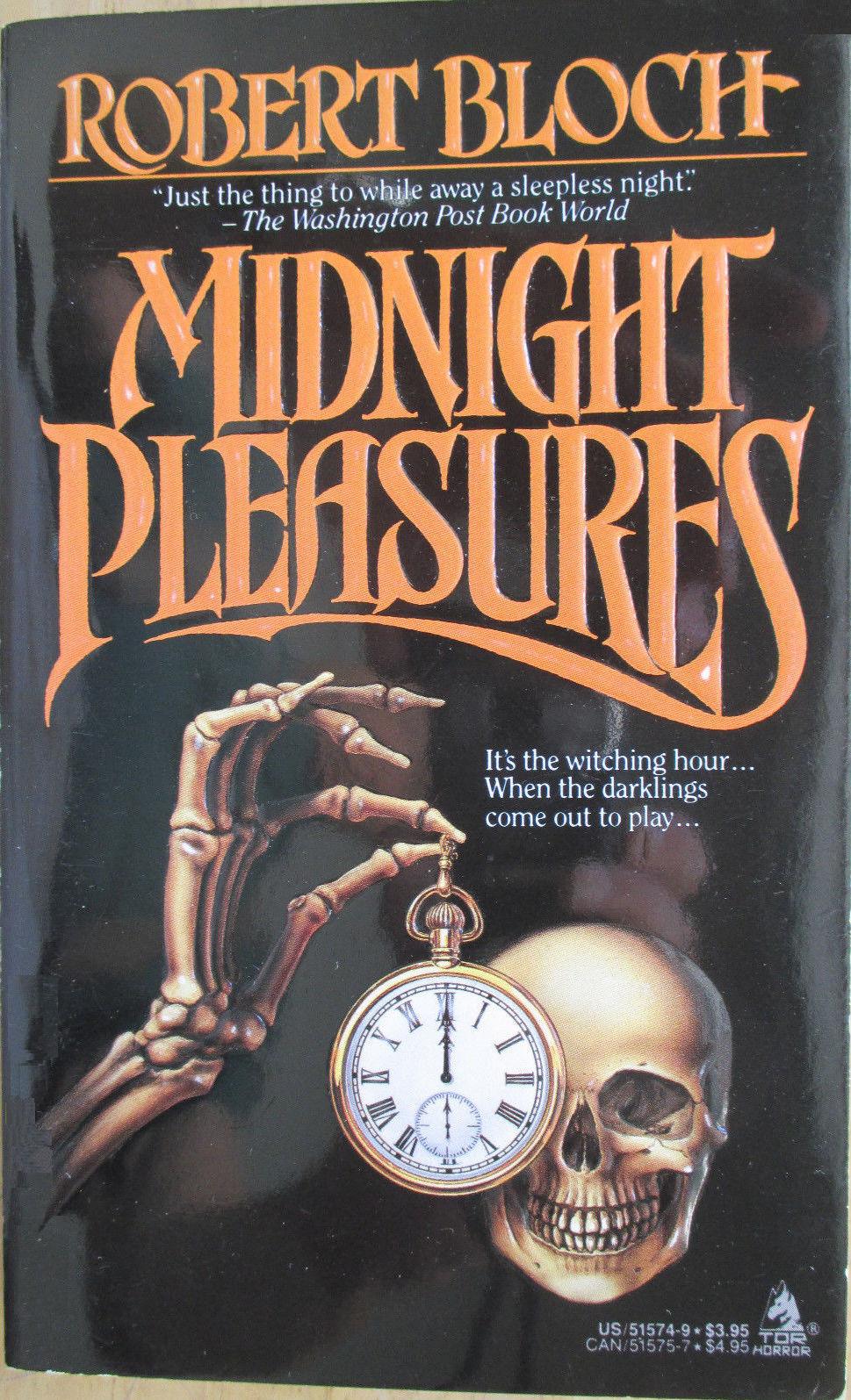
Vintage Treasures: Midnight Pleasures by Robert Bloch
Thursday, July 23rd, 2015 | Posted by John ONeill
Midnight Pleasures Robert Bloch-small
Ed here: John right. We sure have forgotten Robert Bloch. He was a huge influence on my generation especially.
Robert Bloch isn’t a name that gets tossed around much these days. Even before his death in 1994, he was primarily known as the author of Psycho, and this one fact overshadowed most of his other accomplishments.
But Bloch was also the author of hundreds of short stories, and over 30 novels, virtually all of which are out of print today. He was one of the most gifted and prolific short story writers in the horror field, and his best short stories are compact treasures. He won a Hugo Award for his 1958 story “That Hell-Bound Train,” and multiple Bram Stoker awards (for the 1993 collection The Early Fears, the novelette “The Scent of Vinegar,” and his 1993 memoir Once Around the Bloch.)
He received a World Fantasy Award in 1975 for Lifetime Achievement, and a Lifetime Achievement Bram Stoker Award in 1990.
Bloch was also one of the youngest members of The Lovecraft Circle, those writers who corresponded with and often consciously emulated H.P. Lovecraft. Lovecraft was one of the first to encourage Bloch’s writing, and a lot of Bloch’s early work for the pulps was Cthulhu Mythos fiction (most of which was gathered in his 1981 collection Mysteries of the Worm.)
Midnight Pleasures is one of Bloch’s last fiction collections (two more appeared before his death: Fear and Trembling in 1989, and The Early Fears in 1994). It’s a fine sample of late horror fiction from one of the best short story writers the genre has seen.
It was nominated for a 1987 Bram Stoker Award for Fiction Collection (it lost out to The Essential Ellison). It contains chiefly later short work, dating from 1977-1985, published in anthologies like New Terrors 2ShadowsMasquesAnalog YearbookDark ForcesChrysalis 3, and others.
It also includes one pulp story (from the August 1939 issue of Weird Tales), and two stories that appear here for the first time: “Comeback” and “Die–Nasty.”
Here’s the complete table of contents:
“The Rubber Room” (New Terrors 2, 1980)
“The Night Before Christmas” (Dark Forces, 1980)
“Pumpkin” (Rod Serling’s The Twilight Zone Magazine, November-December 1984)
“The Spoiled Wife” (Chrysalis 3, 1978)
“Oh Say Can You See–” (Analog Yearbook, 1978)
“But First These Words—” (The Magazine of Fantasy & Science Fiction, May 1977)
“Picture” (Shadows, 1978)
“The Undead” (The Undead: The Book Sail, 16th Anniversary Catalogue, 1984)
“Comeback”
“Nocturne” (The First Chronicles of Greystone Bay, 1985)
“Die–Nasty”
“Pranks” (Halloween Horrors, 1986)
“Everybody Needs a Little Love” (Masques, 1984)
“The Totem-Pole” (Weird Tales, August 1939)
About the Author
--------------------------------------------------------------------------------------------------------------------------

Gravetapping from Ben Boulden


Posted: 09 Aug 2015 08:00 AM PDT
“Baker feared his boss, Klotscher feared God, Mrs. Annixter feared cancer, which was a polite term for syphilis, which was a polite term for intercourse, which was a polite term for the Sin Against the Holy Ghost, which was a polite term for the fact that she really enjoyed it. By a strange coincidence, Mr. Annixter was a patient too, and he feared—Mrs. Annixter.”

—Robert Bloch, Spiderweb. Hard Case Crime paperback, 2008 (© 1954); page 85. First person narrative of the protagonist, Eddie Haines.

[No Comment is a series of posts featuring passages from both fiction and non-fiction that caught my attention. It may be the idea, the texture, or the presence that grabbed my eye. There is no analysis provided, and it invariably is out of context—since the paragraph before and after are never included. ]

Purchase a copy of the Hard Case Crime edition of Shooting Star / Spiderweb at Amazon.

Saturday, December 10, 2011

BEHIND THE BATES MOTEL: Robert Bloch


Ed here: I've been reading a collection of Robert Bloch's stories this week and remembered a fine piece about Bloch written by the always entertaining and insightful Paula Guran.

BEHIND THE BATES MOTEL: Robert Bloch

August 1999
By Paula Guran

"PSYCHO all came from Robert Bloch's book." -- Alfred Hitchcock

With the current centennial of Alfred Hitchcock's birth being noted with various events and symposia, I can't help but observe that PSYCHO -- the most notorious and perhaps best known of all of Hitchcock's films -- was adapted from a novel of the same name by Robert Bloch. As Douglas E. Winter put it in his 1985 FACES OF FEAR, "Two masters of horror have been immortalized by the motion picture PSYCHO...One, of course, is its director, Alfred Hitchcock; the other is the man who wrote the novel on which it is based. And no one ever said it better than Hitchcock himself: 'PSYCHO all came from Robert Bloch's book.'"

Before his death in 1994 at age 77, Bloch often joked that his obituary would begin with PSYCHO, a novel that was just a tiny part of his flood of work. Of course, he was right. And, although Mr. Bloch might disagree, perhaps that's the way it should be. PSYCHO, both the film and the book, had a resounding effect on both literary and cinematic horror. Quoting Winter again, "From the Depression heyday of WEIRD TALES and the evocative Universal film adaptations of FRANKENSTEIN and DRACULA, the tale of terror had suffered until the mid-1950s, as if the real horrors of World War Two had snuffed out the human need for fictional confrontation with death. Not until the Eisenhower era did the monsters reemerge in force: first in the innocuous science-fictional context of the "big bug" films, then in the exuberant American International youth films like I WAS A TEENAGE WEREWOLF (1957), and finally in the serious context of films and books like PSYCHO."

PSYCHO, however, was not Bloch's first or last exploration of psychopathology or the only way in which he influenced modern horror fiction.

fo the rest go here: http://www.darkecho.com/darkecho/horroronline/bloch.html

Sunday, October 05, 2014

great Cullen Gallagher review of The Scarf by Robert Bloch


by Cullen Gallagher
rMost famous for writing the original novel of Psycho, which Alfred Hitchcock based his movie on, Robert Bloch had a writing career that spanned not only nearly his whole life, but also the 20th century. Born in 1917 in Chicago, IL, Bloch sold his first short story to Weird Tales in 1934 - when he was just seventeen years old! Before his death in 1994, Bloch published twenty-five novels and hundreds of short stories that ranged from horror to mystery to science-fiction, as well many other works for television, radio, movies.

His first novel, The Scarf (Avon #494) was published in 1947. It tells the story of a writer, Daniel Morley, who uses real women as models for his characters. But as soon as he is done writing the story, he is compelled to murder them, and always the same way: with the maroon scarf he has had since childhood. We start in Minneapolis and follow him and his trail of dead bodies to Chicago, New York, and finally Hollywood, where his hit novel is going to be turned into a movie, and where his self-control may have reached its limit.

Bloch uses a first-person narration that puts us not only in the mind of Daniel, but also in his hands as he crafts his stories and wraps the scarf around the necks of his victims. In many ways, it reminded me of Jim Thompson’s psychological noir thrillers such as The Killer Inside Me or Pop. 1280. A key difference is that Bloch is interested in finding the root of the character’s psychology, whereas Thompson doesn’t rationalize psychosis but instead confronts the reader face-to-face with it. Both writers each have their distinct approach, and each of them is disturbing in their own ways. Neither novelist will leave you feeling comfortable and secure – but instead touches something deep and dark within you, that little piece of security that makes you believe that the world will be all right tomorrow. In Bloch and Thompson’s world – nothing is all right tomorrow, and it never will be.

Bloch also seems to have channeled his own frustrations as a writer into The Scarf. Daniel Morley continually doubts his own creative talents, and is particularly pessimistic about the financial and commercial possibilities as a writer. Here is just one such passage, brimming with a young author’s anxieties:

“Did you ever stop to think about this angle? Thousands of guys are beating their brains out every year writing books. Every broken-down hack that ever had a job on a newspaper or in advertising sooner or later gets the idea that he’s going to write The Great American Novel. And hundreds of the damn fools actually do write their books and get them published, every year. How many of those hundreds of novels have you read this year? How many do you think anybody has read? […] You can starve to death in that racket, son. And here’s another encouraging thought: you’ve written one book, but how do you know you can write another? The woods are full of one-book authors…”

Below are a few more of my favorite quotes from the novel:

“Did you ever try to punch a raw oyster? That’s the way it was, fighting with Hazel Hurley.”

“As I turned and ran down the steps, I thought I could hear her scream. But it was only the grinding halt of the train.”

“Her voice gurgled like water in a faucet. I turned it off.”

“I open the notebook and take up the pen, and here I am, playing with words again. Even in crisis and despair, I play with words. Crisis…despair – they’re words, too.”

If you’d like to read more Robert Bloch, head over to Hard Case Crime and sample chapters from Shooting Star and Spiderweb – two other excellent novels worth picking up, and published together in a cool, vintage “back to back” format!

You can also find several interviews with Bloch online, essays about him, and links to his stories, at The Unofficial Robert Bloch Homepage. Petri Liukkonen and Ari Pesonen have also written an informative essay and bibliography.

Thursday, July 24, 2014

Forgotten Books: The Dead Beat by Robert Bloch


I've always admired the novel that Robert Bloch wrote immediately following publication of Psycho. I am one of four people on the planet who can make that claim.

What I've always liked about it is the way Bloch took a sleazy no-good psychotic bastard and set him right down in the middle of a Midwestern family that could have doubled as sit-com people. Bloch really makes you care about these folks and how they are so slow to catch on to the psychotic jazz musician they make the mistake of trying to help.

The title signals the era, the early sixties when the Beats were so much in the news. Bloch shows us a kind of faux beat existence with the musicians we meet early on. Bloch gets the one night stand life (in both meanings of that phrase) down just as well as he gets the middle-class days and nights of the family the musician will ultimately turn on. For Bloch this is a return of sorts to his Fifties paperbacks such as The Will To Kill and The Kidnapper. Jim Thompson country before anybody knew who Thompson was. (Bloch bristled when I asked him once if Thompson had ever been an influence--he said he'd never heard of Thompson until much, much later.)

Reviewers of the time didn't like the relatvely slow pace. They also complained that the novel didn't offer the shock or sass of Psycho (I say sass because the novel is very funny in places--something Hitchcock picked up on immediately). I like the treachery and the darkness here. I didn't used to believe in evil. But now I do. Robert Bloch brings to life the kind of evil all around us.


Saturday, November 09, 2013

"The Scarf" review by Cullen Gallagher Pulp Serenade


"The Scarf" by Robert Bloch (Avon, 1947)


Ed here: Like many, many people I miss my daily fix of Pulp Serenad. Here's a Golden Oldie.

Cullen Gallagher:


Most famous for writing the original novel of Psycho, which Alfred Hitchcock based his movie on, Robert Bloch had a writing career that spanned not only nearly his whole life, but also the 20th century. Born in 1917 in Chicago, IL, Bloch sold his first short story to Weird Tales in 1934 - when he was just seventeen years old! Before his death in 1994, Bloch published twenty-five novels and hundreds of short stories that ranged from horror to mystery to science-fiction, as well many other works for television, radio, movies.

His first novel, The Scarf (Avon #494) was published in 1947. It tells the story of a writer, Daniel Morley, who uses real women as models for his characters. But as soon as he is done writing the story, he is compelled to murder them, and always the same way: with the maroon scarf he has had since childhood. We start in Minneapolis and follow him and his trail of dead bodies to Chicago, New York, and finally Hollywood, where his hit novel is going to be turned into a movie, and where his self-control may have reached its limit.

Bloch uses a first-person narration that puts us not only in the mind of Daniel, but also in his hands as he crafts his stories and wraps the scarf around the necks of his victims. In many ways, it reminded me of Jim Thompson’s psychological noir thrillers such as The Killer Inside Me or Pop. 1280. A key difference is that Bloch is interested in finding the root of the character’s psychology, whereas Thompson doesn’t rationalize psychosis but instead confronts the reader face-to-face with it. Both writers each have their distinct approach, and each of them is disturbing in their own ways. Neither novelist will leave you feeling comfortable and secure – but instead touches something deep and dark within you, that little piece of security that makes you believe that the world will be all right tomorrow. In Bloch and Thompson’s world – nothing is all right tomorrow, and it never will be.

Bloch also seems to have channeled his own frustrations as a writer into The Scarf. Daniel Morley continually doubts his own creative talents, and is particularly pessimistic about the financial and commercial possibilities as a writer
 or the rest go here:
http://www.pulpserenade.com/2009/03/scarf-by-robert-bloch-avon-1947.html

Wednesday, September 29, 2010

Forgotten Books: THE DEAD BEAT by Robert Bloch


I've always admired the novel that Robert Bloch wrote immediately following publication of Psycho. I am one of four people on the planet who can make that claim.

What I've always liked about it is the way Bloch took a sleazy no-good psychotic bastard and set him right down in the middle of a Midwestern family that could have doubled as sit-com people. Bloch really makes you care about these folks and how they are so slow to catch on to the psychotic jazz musician they make the mistake of trying to help.

The title signals the era, the early sixties when the Beats were so much in the news. Bloch shows us a kind of faux beat existence with the musicians we meet early on. Bloch gets the one night stand life (in both meanings of that phrase) down just as well as he gets the middle-class days and nights of the family the musician will ultimately turn on. For Bloch this is a return of sorts to his Fifties paperbacks such as The Will To Kill and The Kidnapper. Jim Thompson country before anybody knew who Thompson was. (Bloch bristled when I asked him once if Thompson had ever been an influence--he said he'd never heard of Thompson until much, much later.)

Reviewers of the time didn't like the relatvely slow pace. They also complained that the novel didn't offer the shock or sass of Psycho (I say sass because the novel is very funny in places--something Hitchcock picked up on immediately). I like the treachery and the darkness here. I didn't used to believe in evil. But now I do. Robert Bloch brings to life the kind of evil all around us.

Sunday, December 02, 2012

The Dead Beat by Robert Bloch


Robert Bloch


A while back writer John Peyton Cooke made the case for The Scarf and not Psycho being Robert Bloch's true masterpiece. I'm not sure I agree but since they're both fine books what the hell.

Cooke's excellent review reminds me of another overlooked Bloch novel, the one that came right after Psycho and that nobody much seemed to care for, namely The Dead Beat. What I've always liked about it is the way Bloch took a sleazy no-good bastard and set him right down in the middle of a Midwestern family that could have doubled as sit-com people. But Bloch really makes you care about these folks and how they are so slow to catch on to the psychotic jazz musician they make the mistake of trying to help.

The title signals the era, the early sixties when the beats were so much in the news. He shows us a kind of faux beat existence with the musicians we meet early on. Bloch gets the one night stand life (in both meanings of that phrase) down just as well as he gets the middle-class days and nights of the family the musician will ultimately turn on.

Reviewers of the time didn't like the relatvely slow pace. They also complained (as I recall) that the novel didn't offer the shock or sass of Psycho (I say sass because the novel is very funny in places--something Hitchcock picked up on immediately). While The Dead Beat certainly isn't Bob Bloch's masterpiece, it's a novel that shows him in a more expansive mood, showing an interest not just in the story but in showing us life as it was lived back in the day.

Monday, March 30, 2015

Gravetapping: "Nina" by Robert Bloch


Posted: 28 Mar 2015 02:37 PM PDT
Robert Bloch is a legend. He is popularly known as a horror writer, but his production was wide and impressive. He wrote extensively in the crime, science fiction and horror genres. He had a particular skill at taking the style of one genre—hardboiled crime—and mixing it with the theme and expectations of another genre—horror. Think Psycho .

I recently read his short story “Nina” and I was impressed (to say the least). Nolan is an American running a plantation in the wild country of Brazil. The closest city: Manaus. The plantation’s only access is by boat, and Nolan isn’t completely comfortable with the workers. It’s not that they don’t work well, but rather it is their ceaseless drumming during the night. Add the heat. The humidity. The mosquitoes. And Nolan is a miserable man.

His life on the plantation changes when a woman appears. She is unknown to the local workers, and Nolan’s translator, Moises, calls her an “Indio” and “savage.” She soon becomes Nolan’s bedmate, and when his wife and child arrive to visit, Nolan’s world is shaken on its head.

“Nina” has all of the elements of a terrific horror story: a foreign and exotic location; a creepy and dark fabric; mysticism; outright strangeness; and a violent, and very peculiar, loss. It is very much horror, but it is brilliantly delivered with hardboiled prose, which provides a raw power—not to mention forward momentum—many horror stories lack:

“After the lovemaking Nolan needed another drink.

“He fumbled for the bottle beside the bed, gripping it with a sweaty hand. His entire body was wet and clammy, and his fingers shook as they unscrewed the cap. For a moment Nolan wondered if he was coming down with another bout of fever. Then, as the harsh heat of the sun scalded his stomach, he realized the truth.”

“Nina” is one of the better genre stories I have read. Its power is heady and visceral with a shadow-like quality; the narrative creates a shifting, soft focus, of the events. The characters feel real and the narrative is perfect. It captures the essence of the story and delivers it with an impressive blend of force and jaded subtlety most writers never achieve.

“Nina” originally appeared in The Magazine of Fantasy & Science Fiction in 1977. I read it in the anthology The Best Horror Stories Volume 1 edited by Edward L. Ferman and Anne Jordan. It was published by St Martin’s Press in 1988.

This was originally posted February 6, 2009, but since I have read a few Robert Bloch short stories recently, and reviewed his fantastic “The Hell-Bound Train”I thought it would be interesting to find some of my prior writings about Mr Bloch’s work. I also reviewed his stories “The Real Bad Friend” and “Lucy Comesto Town” in 2014.

Wednesday, May 20, 2009

Robert Bloch; Terrill Lankford


"This is a thread that runs through all of my mystery/suspense fiction," Bloch has pointed out. "The terrible inability to understand the irrational behavior of certain human beings, what is it that impels that sometime senseless sadistic cruelty, and I tried to familiarize myself with it because I can recognize that, deep down within, there are certain of those aspects within myself which I probably manage to exorcise by way of the typewriter."
--Robert Bloch

Last night and this afternoon I read The Will To Kill by Robert Bloch. When you pair this one with his novel The Kidnapper you discover that in his own quiet way Bloch was writing horrorific noir fiction way back in the mid-Fifties, the same kind of fiction so much in vogue today. While I've seen both novels compared to Jim Thompson and Cornell Woolrich, Bloch told me once that he'd never read Thompson, though he readily acknowledged the Woolrich influence. But these two short books are unique in voice and storyline and are, in some respects, two sides of the same story--the man who fears he's a killer and the man who revels in being a killer. They're both claustrophobic as hell. You're completely inside the mind of the man narrating the stories. The Kidnapper should be easy to find. It was reprinted in the late eighties by Tor. Will is hard to come by but well worth the search.

TERRILL LANKFORD HAS POSTED A fine FOLLOW UP TO HIS PREVIOUS MICHAEL CONNELLY VIDEO

http://www.youtube.com/watch?v=P8hX-vkB_yo

Thursday, October 27, 2011

Forgotten Books: Shooting Star and Spiderweb by Robert Bloch

Shooting Star and Spiderweb by Robert Bloch

Though Robert Bloch made his reputation with horror or horrorific stories and novels, he worked steadily throughout his career in the mystery and crime genres. Shooting Star, one half of the new Hardcase Crime double book (more of these please), is not only crimonious it's also set in Hollywood, one of Bloch's abiding fascinations.

The hook here is novel for those of us who can remember how actor William Boyd bought up all his Hopalong Cassiday movies when they fell from popularity in the Forties and later sold them to TV. Buy low sell high. They brought him millions. Failed literary agent Mark Clayburn, now paying the bills as a private eye, is hired to prove that a Boyd-like actor wasn't the decadent man the press revealed him to be following his murder. The man who hires Clayburn bought up the dead star's Hoppy-like movies and expected to make a fortune. But since the films are aimed at kids...who wants to see a hero whose tastes off-screen were, to be gentle about it, sleazy.

In Spiderweb failed actor Eddie Haines is hired to be a "psychiatric consultant" to the stars by a rather arch villain named Professor Hermann. By blackmailing Eddie, Hermann has found the perfect tool for his racket. There are moments that reminded me of Nightmare Alley throughout the book and more than a few scenes that move the novel into the kind of realistic horror of Psycho. Shooting Star is driven by its mystery storyline; Spiderweb, though the storyline is less focused, depends on shock material to keep you turning the pages.

Neither of these novels is major Bloch but both deserve reading. For one thing they encapsulate a number of the obsessions, sociologically, of the Fifties. For another we see the dark side of Bloch's obsession with Hollywood. In such masterpieces as his short story The Movie People we see his almost innocent sense of what the movies gave to him as a youth. When he speaks of Chaplin and Keaton and Lloyd it's as if he's speaking of secular saints. The movies of his boyhood are holy to him.

In these novels and many short stories he deals with the business side of Hollywood. The voice becomes by turns sardonic and angry as he witnesses the passion and beauty of the great films and film artists reduced to power plays and dishonest deals rendered by men who have no idea what they're defiling.

I enjoyed both of these books enormously.

Friday, April 24, 2015

Two Classic Shows, Two Unusual Takes on Jack the Ripper classicfilmtvcafe.com


From the great website classicfilmtvcafe.com
http://www.classicfilmtvcafe.com/

The suspense master Robert Bloch 

Numerous TV series and films have offered imaginative twists on the mysterious murderer that terrorized the Whitechapel district of London in the late 1880s. Two of my favorite big screen versions are the time travel fantasy Time After Time (1979), which pits H.G. Wells against the Ripper and A Study in Terror (1965), which has Sherlock Holmes facing off against Jack (a premise borrowed by the later Murder By Decree). Two of the most intriguing small-screen Ripper tales appeared as episodes of Thriller and the original Star Trek. Interestingly, Robert Bloch--best known for writing the novel that became Psycho--had a hand in both TV series.


John Williams in Thriller.
The Thriller episode "Yours Truly, Jack the Ripper" starred John Williams (a Hitchcock semi-regular) as an expert engaged by the Washington, D.C. police to help apprehend a modern day Ripper-like murderer. As the gruesome killings mount, a fantastic theory emerges: Is the murderer actually Jack the Ripper himself, who has used black magic rituals to defy ageing? It’s a clever premise and the big twist at the end works pretty well (even though you’ll guess it). Although Bloch wrote several episodes of Thriller, this teleplay was written was Barré Lyndon and based on a Bloch short story. Published in 1947, the story “Yours Truly, Jack the Ripper” originally appeared in Weird Tales. It was the first of several literary works in which Robert Bloch incorporated Jack the Ripper.

This episode also features several Hitchcockian connections. First, it was directed by Ray Milland, who played the killer in Alfred Hitchcock’s Dial M for Murder. The police inspector in that film? That would be John Williams. Decades earlier, Hitchcock also tackled Jack the Ripper with his 1927 silent film The Lodger, which was adapted from a short story and play by Marie Belloc Lowndes. And, for one final connection, the Alfred Hitchcock Presents episode “The Hands of Mr. Ottermole” boasts some Ripper overtones with its plot about a strangler running amok in a very foggy London.


John Fiedler in Star Trek.
Star Trek seems like an unlikely destination for Jack the Ripper, which is precisely what makes “Wolf in the Fold” a compelling season two episode. While on shore leave on the planet Argelius II, a bewildered Scotty is  found—bloody knife in hand—standing over the corpse of a nightclub dancer. He has no recollection of what happened, but the evidence is damning and chief administrator Hengist (John Fiedler) seems convinced that Scotty is guilty.

For many years, I listed this as one of my favorite Star Trek episodes. I viewed it recently, though, and while still good, it hasn’t aged as well as others. Still, Fiedler is very good (he’s perhaps best remembered as Piglet in Disney Winnie the Pooh movies and TV shows). This time around, Bloch wrote an original teleplay and borrowed the central premise of “Yours Truly, Jack the Ripper.” There are some nice touches, too, such as the foggy streets on Argelius substituting for London and Kirk’s use of the ship’s computer in revealing the murderer’s identity.

Television continues to sporadically visit the Jack the Ripper murders, with season one of the 2009-2013 British TV series Whitechapel focusing on a copycat  killer.


Posted by Rick29 at 6:00 AM 6 comments 


Recommend this on Google

Wednesday, December 14, 2011

What do Isaac Asimov, Robert Bloch, Harlan Ellison. James Gunn, Jack Vance, and Donald Westlake have in common?


Ed here: For people like Bill Crider and me the announcement that follows is like the pearly gates opening up. There was no other sf mag like Super-Science Fiction. Scoffers might say that no other sf mag WANTED to be like Super-Science but if you were the right pimply age no other mag provided the same thrills. The copy below tells you all about it. Once again the great Haffner Press comes through.

Tales From Super-Science Fiction

Edited by Robert Silverberg
Illustrated by Frank Kelly Freas & Ed Emshwiller
ISBN: 9781893887480
$30.00
400+ pp. Hardcover
Color endpapers


(coming soon)

Description
Robert Silverberg has assembled a collection of 14 stories from Super-Science Fiction. S-SF was launched during the sf boom of the mid-1950s. Paying a princely rate of 2 cents a word the magazine attracted fiction by Isaac Asimov, Robert Bloch, Harlan Ellison. James Gunn, Jack Vance, and Donald Westlake, and featured cover art by Frank Kelly Freas and Ed Emshwiller. Running for 18 bi-monthly issues (Dec ‘55 to Oct ‘59), the magazine eventually devolved into a publication capitalizing on the then-current craze of “monster” stories.

Editor Silverberg traces the genesis of Super-Science Fiction from it’s beginnings as an outlet for numerous colonization/expedition stories to its conclusion with such stories as “Creatures of the Green Slime,” “Beasts of Nightmare Horror” and “Vampires from Outer Space.” It’s fun, it’s cheesy, and we’re really looking forward to it!

Table of Contents
Reviews
Excerpts


Table of Contents
Introduction by Robert Silverberg
"Catch 'Em All Alive" by Robert Silverberg
"Who Am I?" by Henry Slesar
"Every Day is Christmas" by James E. Gunn
"I'll Take Over" by A.Bertram Chandler
"Song of the Axe" by Don Berry
"Broomstick Ride" by Robert Bloch
"Worlds of Origin" by Jack Vance
"The Tool of Creation" by J.F. Bone
"I Want to Go Home" by Robert Moore Williams
"Hostile Life-Form" by Daniel L. Galouye
"The Gift of Numbers" by Alan E. Nourse
"First Man in a Satellite" by Charles W. Runyon
"A Place Beyond the Stars" by Tom Godwin
"The Loathsome Beasts" by Dan Malcolm (aka Silverberg)

Friday, December 12, 2008

Robert Bloch

On The Rap Sheet tonight writer John Peyton Cooke makes the case for The Scarf and not Psycho being Robert Bloch's true masterpiece. I'm not sure I agree but since they're both fine books what the hell.

Cooke's excellent review reminds me of another overlooked Bloch novel, the one that came right after Psycho and that nobody much seemed to care for, namely The Dead Beat. What I've always liked about it is the way Bloch took a sleazy no-good bastard and set him right down in the middle of a Midwestern family that could have doubled as sit-com people. Bloch really makes you care about these folks and how they are so slow to catch on to the psychotic jazz musician they make the mistake of trying to help.

The title signals the era, the early sixties when the beats were so much in the news. He shows us a kind of faux beat existence with the musicians we meet early on. Bloch gets the one night stand life (in both meanings of that phrase) down just as well as he gets the middle-class days and nights of the family the musician will ultimately turn on.

Reviewers of the time didn't like the relatvely slow pace. They also complained (as I recall) that the novel didn't offer the shock or sass of Psycho (I say sass because the novel is very funny in places--something Hitchcock picked up on immediately). While it's certainly not Bob Bloch's masterpiece, it's a novel that shows him in a more expansive mood, showing an interest not just in the story but in showing us life as it was lived back in the day.

Tuesday, February 02, 2010

Forgotten Books: The Scarf by Robert Bloch; Mystery Scene Winter Issue

"This is a thread that runs through all of my mystery/suspense fiction," Bloch has pointed out. "The terrible inability to understand the irrational behavior of certain human beings, what is it that impels that sometime senseless sadistic cruelty, and I tried to familiarize myself with it because I can recognize that, deep down within, there are certain of those aspects within myself which I probably manage to exorcise by way of the typewriter."

This was Robert Bloch talking to an interviewer about why his early career shifted from Lovecraftian horror to the more frightening horror of the human mind.

Bloch had long been fascinated with the fact that while some killers were transparent many others were hidden safely inside a studied disguise of normality.

Daniel Morley, for instance, the narrator of The Scarf, is a young man gliding through life. First a novelist and then a screenwriter, always attractive to women and smooth with the men he must deal with.

One thing I admire about this novel is Morley's agonizing over what he does. He is not in control of his urges and he suffers for it. He's not the sleek stereotype of the mastermind serial killer of today. And his fetishistic attachment to the red scarf with which he strangles his victims haunts his nightmares.

I'm sure many readers will disagree with me that The Scarf is at least the equal of Psycho and maybe even a little bit better. Bloch had a good time playing humor off the Norman Bates character. You could even imagine Bloch smiling if not laughing out loud in places. For that reason I suspect that the Daniel Morley character was more difficult to make human. More pitfalls in making him believable. This is Jim Thompson country.

Much of Bloch's work has faded, the fate of most prolific writers. I was never a particular fan of his humor and it has not worn well. But he wrote two remarkable and timeless novels, Psycho and The Scarf, and a fine single volume collection of his very best stories could be set on the same shelf with the two books.

Hell, very late in his career he wrote a masterpiece, the long story "The Yugoslavs," one of the finest, darkest and most original stories I've ever read. The Scarf is well worth looking up.


--------------------------------------------From Kate Stine at Mystery Scene Magazine

Dear Readers,

January has flown by. In between big mystery award announcements; welcoming Mystery News readers; and diving into the MS Blog, Twitter, and Facebook; we're also finishing up a great looking Winter Issue #113, which should be out mid-February.

We're looking forward to bringing you a terrific cover story with Randy Wayne White, as well as a chat with G.M. Malliet, Lawrence Block's memories of Ross Thomas, a tribute to G.K. Chesterton's Father Brown, and a look at P.D. James's new Talking About Detective Fiction. Hope your 2010 is off to a wonderful beginning and we'll see you next month.

Sincerely,
Kate Stine
Editor-in-Chief