Tuesday, May 07, 2013

Ed's western fiction; Mary Cannon


SHORT STORY SUNDAY with Troy D. Smith

 (From Western Fictioneers)

Today I'm going to highlight the second unit in a three-way tie for my all time favorite western short story -last month I talked about the first, "The Last Boast" by Dorothy Johnson.

This time around it is Ed Gorman's "The Face," winner of the 1993 Spur Award. It was anthologized a couple of times in the 1990s, and I think I may have seen it for the first time in the pages of Louis L'Amour Western Magazine, if I remember correctly.

GUNSLINGER

TALES OF THE AMERICAN WEST

I am going to throw around some superlatives here. Ed Gorman is one of the best writers alive today, in any genre. I'm far from the only person to feel that way, I am sure. And this work is one of his best -in fact, in my opinion it is one of the best short stories written about the American Civil War, ever. It is a profound, disturbing, thought-provoking, poetic, and subtly terrifying tale. In his introduction of the story found in the book mentioned above, Richard S. Wheeler said: "It is the most haunting study of men at war that I have ever read. It brims with horror and beauty and darkness and evil."

 I can't really give much away -in large part because Gorman's artistry in this particular work has little to do with plot and everything to do with tone and atmosphere. In a nutshell, though, "The Face" is about the effect on a Confederate military camp when a wounded man is brought in, immobile, an empty shell of a person, really -with his face seemingly permanently frozen into a horrifying expression that defies definition. The reader soon intuits that those features reflect all the horrors and grief of war in human experience. The soldiers, and the reader, are -to put it in contemporary terms -freaked the frack out. As we should be.


NOW AVAILABLE
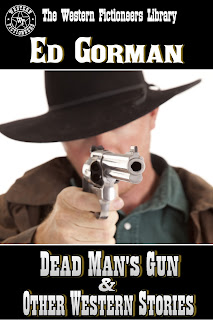

DEAD MAN'S GUN & OTHER WESTERN STORIES by Ed Gorman


From acclaimed author Ed Gorman and the Western Fictioneers Library comes this powerful collection of Western stories, many of which have never been reprinted. This volume includes the stories "Dead Man's Gun", "Pards", "The Old Ways", "The Face", "Gunslinger", "Guild and the Indian Woman", "Mainwaring's Gift", "Blood Truth", "Dance Girl", and the article "Writing the Modern Western". Gorman's unforgettable stories feature fine writing, compelling characters, and an undeniable sense of authenticity and realism. You can feel the cold, smell saddle leather and gunsmoke, mourn along with the tragedy-haunted men and women who populate Ed Gorman's West. Read DEAD MAN'S GUN and see why Ed Gorman is one of today's most honored Western authors.


If you haven't read the work of Ed Gorman, this is a good place to start... but so is anything he has written, really.

HAPPY BIRTHDAY MARY CANNON

One of our great good longtime friends. Thanks for  that great Care package you sent us when we were at Mayo, Mary.

Monday, May 06, 2013

The Worst 'Great Gatsby' Review Lines You Won't Be Seeing on Ads This Week


Ed here: I've never been able to figure out how Baz Luhrmann gets work.He's not a storyteller, he's not
in any meaningful sense an innovator and he has apparently never sat down and talked to a human being for any length of time. Just putting Nick Carraway in a mental hospital is enough of an arrogant and unenlightened misstep to doom the entire picture.  

Here is The Atlantic Wire.com:


The first round of movie reviews have arrived for Baz Luhrmann's adaptation of The Great Gatsby — and they are decidedly mediocre. Everyone kind of saw this coming; this was Gatsby all gussied up with lavish designer costumes, 3D, and Jay-Z, after all. We now know that Luhrmann has added the framing device of Nick Carraway telling the story as an alcoholic from a sanitarium, but much of the initial shrugging remains. The consensus seems to be that translating Carraway's first-person narration is a tricky task at which Luhrmann doesn't really succeed, and that Aussie newcomer Elizabeth Debicki deserves praise as Jordan Baker. As for the rest of it, well, let's just say these one-liners won't exactly get blurbed on posters, trailers, or any marketing material whatsoever ahead of Friday's release:
"It's as if every bit of creativity dried up the moment the deal was signed." — Drew McWeeny of HitFix
"Periodically, as if by accident, something like real emotion pokes up through the film’s well-manicured surface..." — Scott Foundas of Variety. 
"The picture is filled with an indiscriminate swirling motion, a thrashing impress of 'style' (Art Deco turned to digitized glitz), thrown at us with whooshing camera sweeps and surges with rapid changes of perspective exaggerated by 3-D." — David Denby of The New Yorker
"Finally this overproduced slimmest of narratives becomes repetitive, at two hours and 23 minutes, as we revisit the sumptuous set pieces, Gatsby looking longingly across the water toward Daisy's glowing green dock, and hear yet another iteration of the morphing Gatsby backstory until we finally reach Carraway's last words..." — Anne Thompson of Indiewire. 
"Maguire's slightly aging boyishness has become tiresome by the film's second half and a reduction of Nick's concluding commentary would have helped." — Todd McCarthy of The Hollywood Reporter

Sunday, May 05, 2013

10 Questions with Duane Swierczynski INTERVIEW BY KEITH RAWSON


10 Questions with Duane Swierczynski


10 Questions with Duane Swierczynski


10 Questions with Duane Swierczynski


Ed here:  I'm a big fan of Duane's and  this is  an excellent interview


Keith  Rawson:

I’ll be the first to admit that I’m a bit of a fanboy when it comes to Duane Swierczynski. I mean, can you really blame me? Philadelphia’s reigning king of pulp is a writing machine, churning out fifteen books since 2002. (And I’m not talking just novels, either. You can’t forget Swierczynski’s two fisted drinking manuals, The Perfect Drink for Every Occasion and The Big Book o’ Beer.) He writes some of the most innovative, off the wall, paranoid thrillers currently being produced—including his latest offering, the third and final book of his Charlie Hardie trilogy, Point & Shoot . Add in all the comic books Swierczynski’s done—including long runs on Iron Fist, Cable, Birds of Prey, Bloodshot, and Judge Dredd—and whatever secret writing projects he has in the hopper, and he probably ranks as one of the busiest crime novelists working. And on top of Duane’s steady diet of words, words, and more words, he’s somehow managed to find the time to teach a class at LitReactor:Like Your Life Depends On It.

What was the first story you ever wrote, and what happened to it?
A three-page gore-soaked tale about an axe murderer written for my eighth grade teacher—who happened to be a Catholic nun. See, we had this weekly assignment to use 20 spelling words in 20 sentences, so I just wrote a single story using all of the words. Sister Marianne loved it, and I went on to write a dozen more installments. Not sure how I wasn’t expelled (or excommunicated), but that was my first taste of writerly success. I still have those stories, packed away in a plastic container somewhere. God, I hope my kids don’t find them.
When you sold your first piece of writing, how did you celebrate?
When I was 17 I sold a short-short story to a horror convention magazine and made something like $50. I’m sure I squandered it on horror paperbacks (scored at Marlo Books, a much-missed indie bookshop in Northeast Philly), as well as photocopying, envelopes and postage for inflicting more stories on unsuspecting small press editors all over the country. Back then, my needs were simple.
I kill a person for every bad review I receive. SO THINK ABOUT THAT, REVIEWERS… (I can hear the heckler in the back row: Then you musta killed lots and LOTS of people!)
Tell us about your process: Pen, paper, word processor, human blood when the moon is full... how do you write?
I started out in grade school with a pen and pieces of loose leaf or a marble copybook, eventually graduating to a manual typewriter, then an electric typewriter, then a Commodore 64 word processing program, then one of those all-in-one word processors (with floppy disks and a built-in printer, which I thought was pretty hot shit for 1989), and then started writing on a computer in college. Though recently I’ve been tempted to grab a fistful of pens and a stack of legal pads and crank out a novel by hand. I’m blessed with the ability to write anywhere, anytime, pretty much—I have no “special place” or rituals. I just need to focus for a short while until the world fades away. Getting that focus, however, can sometimes be a bitch.
I always start a novel with two Word files: a journal to myself (to record stray plot thoughts, character notes, etc.) and then the actual novel file. The journals would probably be incoherent to anyone else… hell, they’re even incoherent to me after a while. I recently opened up a journal where I was planning a sequel to my first novel, Secret Dead Men, and it was almost gibberish. I have no idea what the hell I was thinking, and that frightens me a bit. Once the novel is well underway, the journal usually falls away, too. It’s like the set of training wheels I need to get started.
for the rest go here: http://litreactor.com/interviews/10-questions-with-duane-swierczynski

Saturday, May 04, 2013

One of my favorite novels -- FREE ON KINDLE DOWN RIVER by STEPHEN GALLAGHER


Ed here: This is one of the most original crime novels of any kind I've ever read. It has a range and power I've seldom encountered in suspense fiction. Stephen Gallagher is a master.

Down River

On May 23rd The Bedlam Detective sees UK publication and in anticipation of the event, we're making the Kindle edition of Down River free for this holiday weekend. You'll have 72 hours in which to grab it, from 12.00am (Pacific Standard Time) on May 4th to around midnight PST on May 6th.
Johnny Mays has the moral conscience of a selfish child in the frame of a plain-clothes police officer. The city is his playground, the rest of us his toys. He likes to find out where we work, where we live, what will scare us most. And Johnny never had a toy he didn't break.
But Johnny starts a car chase, and he pushes it too far. Soon they're fishing for his body at the foot of a dam, and partner Nick Frazier has been left behind.
They were friends, once, a long time ago, and there's no greater anger than that of a friend who feels betrayed. Nick had hoped that he might keep Johnny from going over the edge, in every sense. But Johnny doesn't see it that way.
Johnny's last words still echo in Nick's mind: "I'm going to remember this. I'm coming back for you."
Then the killings start. Killings of people Johnny didn't like. While Johnny's car is dredged up, empty.
"The denouement, thanks to Gallagher's strong writing and excellent characterisations, is unforgettable." (Publishers Weekly)
"An out-and-out novel of paranoia, tension and sharply honed violence which confirms Gallagher as one of Britain's most exciting writers of literate, nerve-shredding thrillers. Down River is Gallagher's most impressive novel to date. He's stripped, oiled and tuned his prose until it growls like a Ferrari, smooth, fast, and very, very powerful. The horror is firmly rooted in reality, yet seems ready at any moment to veer into deep, dark shadows... an unstoppable, gut-wrenching ride to the last page."(Starburst)
"Oktober broke new ground in its blending of genres, its thoughtful characterisation, and its non-stop action. With Down River, Gallagher returns to his own brand of police procedural once more... and he's pulled it off brilliantly." (Mystery Scene)

The future is no fun: Self-publishing is the worst


The future is no fun: Self-publishing is the worst


The future is no fun: Self-publishing is the worst

I published three novels at big houses to good reviews. Now I'm my own publisher, and the media wants no part of me


Stick with me on this.
In 2001 when my first novel, “Slab Rat,” was published and I was important for about eight weeks, I was asked to write three very short stories for a literary magazine. I believe the maximum amount of time I was allotted for each story was 10 minutes. Sometimes it takes me 10 minutes to get a sentence the way I want it, but I decided to do it. I forget what the other two stories were, but one of them stayed with me: It was about a couple who go to real estate open houses to steal medication.
Cut to early spring 2012.
Thirty painkillers (prescribed for my bad back) were stolen out of my medicine cabinet. I was certain I knew who did it: someone in my building who had access to our keys. I set a trap for him and removed the remaining painkillers and replaced them with an over-the-counter painkiller that resembled them in color and shape — but certainly did not deliver the same relief. A week later I left my apartment for a mere 10 minutes; when I returned, sure enough, about 30 more were missing. A check of the log revealed who had signed out the keys. As Michael Corleone says to his brother in “The Godfather II”: “I know it was you, Fredo.”
Around the same time last year, my third novel, “Pocket Kings,” was published. As best as I can remember, it did not receive one negative review. There were some flat-out raves, too. The Washington Post loved it and it was an Editor’s Choice in the New York Times Book Review. This was the first time that the Times had liked a book of mine. They cold-bloodedly butchered the first and fatally wounded the second.
“Pocket Kings” got positive reviews, but the problem is it just didn’t get too many of them. As far as I know, only one newspaper west of the Pecos (the Dallas Morning News), reviewed it. Newspapers don’t cover books anymore, of course. And then there’s the lack of a readership on my part, I’m just not that prominent, etc. But why wouldn’t newspapers or magazines in Las Vegas cover a novel about poker? Why wouldn’t the Huffington Post and Gawker mention a book that drills a thousand new assholes into book publishing? Why wouldn’t every newspaper, magazine and website, after they saw that the Times liked a novel, then grab the baton and run with it and review my novel? After all, that’s what issupposed to happen. That and movie offers and Christina Hendricks on my lap and cases of Cristal and a large advance for the next book.

for the  rest go here:
http://www.salon.com/2013/05/03/the_future_is_no_fun_self_publishing_is_the_worst/

Friday, May 03, 2013

The Saint & The Falcon & Raymond Chandler


Ed here: I dimly recall seeing the Falcon (later The Saint) series in second run houses in the early Fifties. 


I still watch and enjoy them. Here's a fine piece from Classic Film and TV Cafe.


Farewell, My Falcon


Raymond Chandler--the creator of Philip Marlowe, one of literature's great detectives--signed a contract in 1941 for RKO to film his novel Farewell, My Lovely. The price: $2000. According to Frank McShane's The Life of Raymond Chandler, it was a decision the writer later regretted, blaming the "unparalleled stupidity on the part of my New York agent."

Even worse, RKO took Chandler's now-acclaimed novel and adapted it as The Falcon Takes Over (1942), a "B" detective film. It was the third entry in the Falcon film series, based on a gentleman detective created by Michael Arlen in a 1940 short story. In fact, the film's opening credits state the screenplay was "based on the character created by Michael Arlen" and then in smaller letters, it includes "From the novel Farewell, My Lovely by Raymond Chandler."


 Surprisingly, the plot adheres pretty closely to Chandler's novel with a big lug named Moose Malloy (Ward Bond) looking for his girlfriend Velma. Moose has recently escaped from the state pen, where he spent five years taking the rap for Velma's boss. Now, he's mad--and that's neck-breaking bad news for anyone getting in his way. After Moose kills a nightclub owner, Gay Lawrence (George Sanders) takes an interest in the case, especially the whereabouts of Velma. He also becomes involved with an alleged necklace theft, a beautiful icy blonde, and a fake psychic. Since this is a plot devised by Raymond Chandler, one can rest assured that somehow it all ties together. (Chandler often interwove plots from previously-written short stories into his novels; for Farewell, My Lovely, the stories were "Try the Girl" and "Mandarin's Jade.")


George Sanders as The Falcon,
with Lynn Bari.


for the rest go here: http://www.classicfilmtvcafe.com/


Thursday, May 02, 2013

Forgotten Books: Rendezvous In Black by Cornell Woolrich


Forgotten Books: Rendezvous In Black by Cornell Woolrich

Forgotten Books: Rendezvous In Black by Cornell Woolrich

This is one of Woolrich's famous "Black" books and black it is. Bleak as David Goodis gets his protagonists usually attempt to make some kind of connection to another human being. Not with with Woolrich.

I'm not going to describe the set-up here because laid it flat it is so outlandish you might think twice about reading the book. But Cornell Woolrich was nothing if not shrewd. By the time you figure out what's going on you've had a chance to prepare yourself. You've been putting it all together piece by piece so when the picture is complete you just nod and accept it.

And anyway as with most Woolrich books and stories the set-up doesn't matter all that much anyway. What makes Woolrich Woolrich is how his protagonists respond to the set-up. This novel is built on a series of richly detailed character studies of several men who have begun dying in ways that would be ironic even to them if they could step back and see it with any objectivity.

Woolrich is often compared to Poe and while I think that's fair--they are both masters of claustrophobia and obsession--I think in all Woolrich's real literary father was Guy de Mauppassant. Woolrich has de Mauppassant's fascination with society high and low for one thing, and a sly ear and eye for realistic daily life. There is a lot of Edward Hopper in Woolrich's word paintings of the Thirties and Forties. I'm not sure that Poe an equivalent interest in his own time.

This is my favorite Woolrich novel which is to say that he has told a story of such cleverness and nihilistic power you see why Woolrich is so revered. This is one of those books, one of those books that crush, and linger on long after you finish it.

Wednesday, May 01, 2013

For Jason Alexander Fans


jasonalexander01

This is from Mark Evanier's fantastic blog News From Me. For the entire piece go here:
http://www.newsfromme.com/

Mark Evanier:


Here’s a little notice that Jason Alexander has had to put out about people who converge on him with stuff to get signed. Like most famous folks, he has to differentiate between people who want one autograph as a treasured momento and people who have a whole pile o’ stuff they want signed so they can sell it on eBay. Whenever you hear that a celeb is bitchy or rude about signing autographs, make sure you know which kind they’re talking about. The seekers in the latter category can be very intrusive, very demanding and sometimes even a menace to public safety.

I’ve met Jason on a number of occasions and for whatever my reporting is worth, he seems to be one of the nicest, most approachable stars around. He’s especially good if you have something more to say to him than, "I’ve always enjoyed your work." Not that he’d probably mind just that.
One night, we were both at a one-performance-only performance of a musical out in Glendale. Being a one-time event, everyone on stage had most of their friends and family there…and most of these performers were young and new at this. After the show, there was an informal party out in the parking lot by the stage door. There, much of the audience mingled with the actors, congratulating them and heaping deserved (in most cases) praise on them. Jason was mingling too and I noticed and was impressed by two things he did.

One was that he approached each and every actor and made a point of giving them some non-gushy, sincere compliments and gentle advice. I didn’t exactly eavesdrop on the conversations but I heard enough to know he was finding something positive and encouraging to say to each performer and none of what I heard sounded phony. It took him a while to make the rounds and make sure he didn’t miss any…and that alone was a fine gesture. But I figured out something else he was doing…
jasonalexander01