Monday, October 13, 2014

New Reviews for Riders On The Storm Published Tomorrow


Riders on the Storm - Ed Gorman     from Rough Edges


If you want to learn about small-town life in America during the turbulent era stretching from the late Fifties to the early Seventies, forget the history books. Just read Ed Gorman's Sam McCain series. It's as perfect a recreation of a time and place (Black River Falls, Iowa, the town where Sam works as a lawyer) as you're ever likely to find. The latest one, and the final book in the series, is RIDERS ON THE STORM, like all the others titled for a song that was popular when it takes place.

As usual, there's a well-plotted mystery for Sam to solve. A psychologically troubled, anti-war Vietnam vet is arrested for the murder of another veteran, a successful businessman and aspiring politician who had beaten up the accused man at a party because of his anti-war views. Sam is friends with the man and doesn't believe he's guilty of murder, so he begins his own investigation to find the real killer. It'll come as no surprise that things are a lot more complicated than they appear to be at first, and Sam puts his own life in danger by trying to sort everything out and clear his friend's name.

Over and above the mystery angle, though, the strongest appeal of the Sam McCain books is Sam himself, with his melancholy yet hopeful observations about life and the people he knows in Black River Falls. Plus all the mentions of the music, the books, the TV shows and movies, that make the novels seem so real for those of us who lived through those days. In so many ways, Ed is us, and we are him.

I've long since given up the pretense of objectivity where Ed's books are concerned. I've been reading and enjoying his books for more than 30 years, the same amount of time that we've been friends. But it's not like I'm the only one praising them, either. He's widely hailed, and rightly so, as one of the best writers of our generation. RIDERS OF THE STORM is a fine conclusion to the Sam McCain series and will leave you glad that you've been able to be a part of Sam's life for the past ten books. Highly recommended.

--------------------
The Seattle Times

The title of Ed Gorman’s“Riders on the Storm”(Pegasus, 208 pp., $25.95) is from a 1971 song by The Doors. It’s an appropriately doomy-gloomy tune released in the year of the book’s setting, when passions ran high over the horrors of Vietnam.
Lawyer and sometime detective Sam McCain, the hero of the prolific Gorman’s long-running series, suffered a serious accident in boot camp and so never saw active military duty. But Vietnam was a different experience for many young men from McCain’s small Iowa town, who came back mutilated in mind or body — or didn’t come back at all.
One who came back damaged is McCain’s friend Will Cullen, who suffers from what we now call PTSD. A rising local politician has a bitter fight with Cullen in public and is murdered soon after, making the vet an obvious suspect. McCain steps in as Cullen’s lawyer, exposing some nasty secrets while defending his friend.
For some readers, the book may not go deep enough in addressing the era’s divisive events, but McCain — an intriguing mix of knight errant and realist — is good and thought-provoking company.
--------------------
Open Salon 
Matthew Paust      Sam McCain's Last Ride?

I will miss Sam McCain. He's the lawyer/detective who thinks he's Robert Ryan. Word on the street is that Riders on the Storm will be his final adventure solving murders in his Iowa hometown. If this is true I don't know what I shall do, because after accompanying him through all ten of his adventures I've begun to think I'm Sam McCain.
Perfectly understandable, I think, identifying with this small-town hero, considering that I grew up in a Midwest town about the same size and character as Black River Falls. And I grew up in my town about the same time Sam does in his. The voice is nice, too. Sam narrates these cases, and by George if he doesn't sound a lot like me!
I don't get the impression Sam wrote these books from today's perspective, either, trying to recall what happened way back when. They're fresh, as if he put the words down on real typewriter paper shortly after they happened. I can only assume novelist Ed Gorman, whose name appears on the covers, found a cache of manuscripts stashed in some dusty rolltop desk in an antique store and has simply been feeding them into a modern digital word-processing thingamajig. Either that or he is really Sam McCain. It can get confusing trying to figure all this out, just as it gets confusing for Sam trying to figure out who the killer is without getting killed himself.
You see, one of the reasons I like Sam so much I sometimes think I'm him is that he doesn't pretend to be a hero. In fact he gets embarrassed with all the attention showered on him when he does happen to act heroically, which occurs at least once in every single case. He sometimes carries his dad's old .45 but I'm not sure he's ever fired it. He gets shot, twice, in Riders on the Storm. I shouldn't say any more about that, however, especially whether he makes it or not. After all, I've already leaked the rumors that this manuscript is the last one in Gorman's stash.
This is not to say there isn't another one or two that might have fallen behind the drawer in that dusty old rolltop. Even if Sam buys it (as detectives said back then) in this one the stories need not be read in sequence. Each can stand on its own. Should Gorman find another one or two nothing really would be lost.
I read them all out of order. The first in the series, The Day the Music Died, I devoured after reading three or four of the others. I started with the third, Will You Still Love Me Tomorrow?, which takes place in 1959. You might be catching the drift here that the title of each story pinpoints the year it took place. Your catch would be right on the money. And it's not just the titles. The novels are chock full of real history. Will You Still Love Me Tomorrow?, for example, opens with Soviet Premier Nikita Krushchev's famous visit to Roswell Garst's Iowa farm.
Your kids tell you their American history class is boring them to death? Get them the Sam McCain history series. They'll ace the exam for the period 1959-71, and be the life of any Rock-n-Roll theme party to boot.
For regular McCain readers, Riders on the Storm has a somberer tone than the others, and that's even before Sam gets shot. It's set right smack amid the Vietnam War malaise. Sam and his friends, the whole town of Black River Falls—in fact the entire country—all are torn asunder by a war it seems only the politicians and those who make money off of war really want. A sad time. And Sam gets shot. Will he live to ride again? To write again?
Or will we have to persuade Ed Gorman to thrust his arm back into that dusty old rolltop one more time?
I sure as hell would miss never being Sam McCain again.

:

Harlan Ellison New from Mark Evanier


Harlan Ellison News

Yes, I've heard that my friend (everyone's friend, actually) Harlan Ellison has been hospitalized with a stroke that has paralyzed his right side. I just spoke with someone who'd spoken with Mrs. Harlan and Susan says his mind is sharp and the rest of him seems unaffected. Sounds like there is every reason for optimism. I'll pass on more news as it becomes available.

David Cronenberg: Why Frustrated Novelists Hate the Screenplay


 From  The Daily Beast by Craig Hubert

Q. The use of language in Consumed is fascinating. The main characters, both journalists, speak in a stylized way that is informed by the products they obsess over and fetishize.

A. It arises naturally because I’m responding to the zeitgeist. I think of it as realism. I mean, there you are [points down to my iPhone recording the conversation]. And these days I’m often doing interviews with guys that I’ve known for years who are print journalists and now they’re trying to do video for their newspapers website with their iPhone. They’re desperate; they’re required to start doing photojournalism, video journalism as well. For me, if I’m going to have two young journalists as my main characters they’re going to be plugged into the Internet, they’re going to be plugged into technology, in self-defense, or passion in this case. I don’t think they even think of it as anything unusual.

Do you think of it as something unusual?

No. I’ve been a techno-geek forever. I couldn’t wait for word processors to get rid of typewriters and I couldn’t wait for digital to get rid of film. I have no nostalgia for it whatsoever. I love the technology and I love the compression of time that it makes possible, and I love the fact that a word processor works much more like your mind works. Your mind doesn’t work in a linear way and neither does the digital world.


Go to The Daily Beast for the rest:

Sunday, October 12, 2014

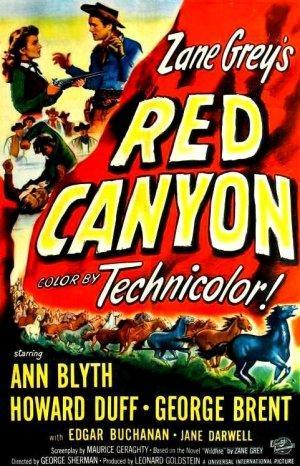
FORGOTTEN WESTERN: RED CANYON(1949)


Red Canyon


FORGOTTEN WESTERN: RED CANYON  (1949)

by Fred Blosser


This is an excellent technicolor Western from Universal-International, script by Maurice Geraghty, directed by George Sherman, from Zane Grey’s novel “Wildfire.”  I like stories that challenge F. Scott Fitzgerald’s famously pessimistic assertion -- you know the one: “There are no second acts in American lives.”  Handsomely mounted and well acted, “Red Canyon” is an engaging, unpretentious tale about second chances that should be better known than it is.
                                       
Drifter Lin Sloane (Howard Duff) and wealthy rancher’s daughter Lucy Bostel (Ann Blyth) are both intent on capturing and taming a magnificant wild stallion, Black Velvet.  Lucy intends to ride the mustang in the town’s big horse race, against her father’s (George Brent) wishes and against his own prized thoroughbred.  Lin catches and corrals the mustang, and Lucy tames it.  The two initially spar, then fall in love.  

Lucy doesn’t know it, but Sloane’s last name is really Cordt, and his father (John McIntire) leads a gang of horse thieves.  The elusive Cordts are her father’s sworn enemies: they were responsible for her mother’s death years before.  Lin, never a part of the gang, has spent years trying to steer clear of the old man by wandering across the Southwest and hiding under the assumed name. When Lin is outed as a Cordt, and his father and brother (Lloyd Bridges) steal Black Velvet, events move toward the inevitable showdown.

Geraghty was an old-timer who wrote everything from serials to episodes of “Annie Oakley” and “Buffalo Bill Jr.” on early TV.  His script for “Red Canyon” deftly streamlines Grey’s rather creaky old novel.  Uncommonly thoughtful, the script draws a subtle association between the outlaw horse Black Velvet and the outlaw-in-name Lin Sloane.  Duff and Blythe are charming in their starring roles.  McIntire and Bridges, abetted by Denver Pyle in an early role, are fine bad guys.  

Geraghty upends a cliche on its head, the old chestnut about the devout father who tries to raise an upstanding son, only to be disappointed when the boy turns bad.  The evil Floyd Cordt shakes his head at his son’s sense of honesty: “The world is full of thieves and murderers.  I tried to teach him, and look how he turned out.”  Bunch of other familar faces in the cast too: Chill Wills, Edgar Buchanan, Hank Worden, James Seay, Jane Darwell, all as welcome as old friends at a reunion.

The film boasts beautifully photographed outdoor scenes of Lin chasing Black Velvet over the desert and through the canyons around Kanab, Utah, and a crackling good climactic shootout that rivals any of John Ford’s, Howard Hawks’, and Sam Peckinpah’s.  The final scenes, which hinge on turning points for both  Lin and Black Velvet, are sentimental -- but then, so were Ford’s movies, and that doesn’t seem to have caused any lasting damage to their reputation, in either a critical or popular sense.

A sharp print of “Red Canyon” runs occasionally on the Encore Western cable channel.  There isn’t a commercially available DVD, although unofficial DVD-R copies are available on the collectors’ market.  A Blu-ray edition is overdue that would do full justice to Irving Glassberg’s cinematography and Natalie Kalmus’ gorgeous technicolor palette.  

Saturday, October 11, 2014

here's a GREAT website http://www.classicfilmtvcafe.com/


FRIDAY, SEPTEMBER 20, 2013


Seven Things to Know About "The Magnificent Seven"

1. The Magnificent Seven (1960) is a pretty faithful adapatation of Akira Kurosawa's classic Seven Samurai (1954)--except that the American Western is 79 minutes shorter! It does have a scene not in the original: the one where Chris (Yul Brynner) and Vin (Steve McQueen) drive the hearse to boot hill.

2. Yul Brynner was the only one of the original cast to appear in a sequel. He reprised the role of Chris for Return of the Seven (1966), which featured Robert Fuller (Laramie) as Vin. In subsequent movies, Chris was played by George Kennedy (Guns of the Magnificent Seven) and Lee Van Cleef (The Magnificent Seven Ride!).

3. Steve McQueen fidgets with his hat frequently during the film--allegedly in an attempt to draw attention to himself. He wasn't a star yet and, in fact, was still headlining the TV seriesWanted: Dead or Alive.

4. Brynner was already a star, of course, but four other Sevenactors went on to achieve film or television fame: McQueen, Robert Vaughn, James Coburn, and Charles Bronson. In fact, McQueen, Coburn, and Bronson reteamed for the 1963 classic The Great Escape. As for the rest of the Seven, Horst Buchholz was already considered a promising newcomer and subsequently appeared in Billy Wilder's One Two Three. That leaves Brad Dexter--who played Harry--as the odd man out. Dexter never came close to stardom, but had a long career as a supporting player; he appeared in several films with best pal Frank Sinatra.

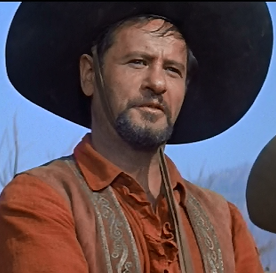
5. In his autobiography, Eli Wallach wrote: “The one regret I had in making The Magnificent Seven was that I never heard Elmer Bernstein’s musical score while making the film. If I had heard that score, I think I would have ridden my horse differently.” Wallach originally wanted to play the Buchholz role--until he read the script and realized that the villainous Calvera was the juiciest part.

6. Elmer Bernstein's music score didn't gain fame until part of it was used in Marlboro cigarette commericials. The Philip Morris Tobacco Company licensed Bernstein's music in 1963 for a Western-themed ad campaign and the rest is history. In fact, it became widely known as the "Marlboro theme." A 1967 album was released called The Music from Marlboro Country, which included musical tracks from The Magnificent Seven and Return of the Seven.

7. Robert Vaughn appeared in two other versions of The Magnificent Seven. He played a mercenary inBattle Beyond the Stars (1977), a low-budget remake that transplanted the premise to an outer space colony harassed by John Saxon's villain. Vaughn's character was "adopted" by the colonists' children (as Bronson's character was by the peasant children in the original). Then, for the 1998-2000 CBS TV series The Magnificent Seven, Vaughn guest-starred as a judge on six episodes.