Friday, April 08, 2016

Gravetapping: Interview: Stephen Mertz

From Ben Boulden and Gravetapping:

Stephen Mertz has written under various pseudonyms, including Don Pendleton,The Executioner, Jack Buchanan, M.I.A. Hunter, Jim Case, Cody’s Army, Stephen Brett, Jon Sharpe, The Trailsman, and Cliff Banks, Tunnel Rats. His early work, as the pseudonyms suggest, was in the high flying men’s adventure genre of the 1980s, but his work has steadily moved from the formulaic action novels to an impressive, and varied, body of work stretching from historical to adventure to paranormal horror.
Mr. Mertz’s first published novel, Some Die Hard, was published as by Stephen Brett by the long ago Manor Books in 1979, and his most recent is an installment in his pulp western seriesBlaze! published earlier this year. In between, he created and wrote a few successful men’s adventure series: M.I.A. Hunter andCody’s Army come to mind. He wrote twelve Mack Bolan books, including the pivotal, and still popular, Day of Mourning, and over the last 15 years he has hit his stride as a novelist writing about a fictional meeting between Hank Williams and Muddy Waters,Hank & Muddy, and an international thriller set in the 2008 Beijing Summer Olympics,Dragon Games.    

Mr. Mertz was kind enough to answer a few questions, and patient enough to keep answering when a few grew into more than twenty. The questions are in italics. The personal photographs are used courtesy of Stephen Mertz.

Your first professional sale was a short story, “The Busy Corpse,” to The Executioner Mystery Magazine.  Would you tell us a little about that experience?

Well, I guess every writer remembers the glorious day he sold his first story or she sold her novel and it’s a red letter day for sure. I was living in Denver at the time. I was running a second-hand record store. I was playing in a blues band, and I’d been writing unpublished (make that unpublishable) stories for years. In 1975, the magazine you mentioned bought that story. The funny thing about it is that I went on to become fairly well associated with the name of Mack Bolan, The Executioner, because about seven years later I ended up writing books for the Mack Bolan series. Actually, it was a coincidence that The Executioner Mystery Magazine bought that story. The editorial staff was out in LA and had nothing to do with Don [Pendleton] other than to use his name on the cover and he had nothing to do with them. The Table of Contents are interesting because it’s a mix of people that I never heard of again and then there are a few old hands like Talmage Powell who are placing some of their final work and there are a handful of new names like me and John Lutz and Margaret Maron who are just breaking in.
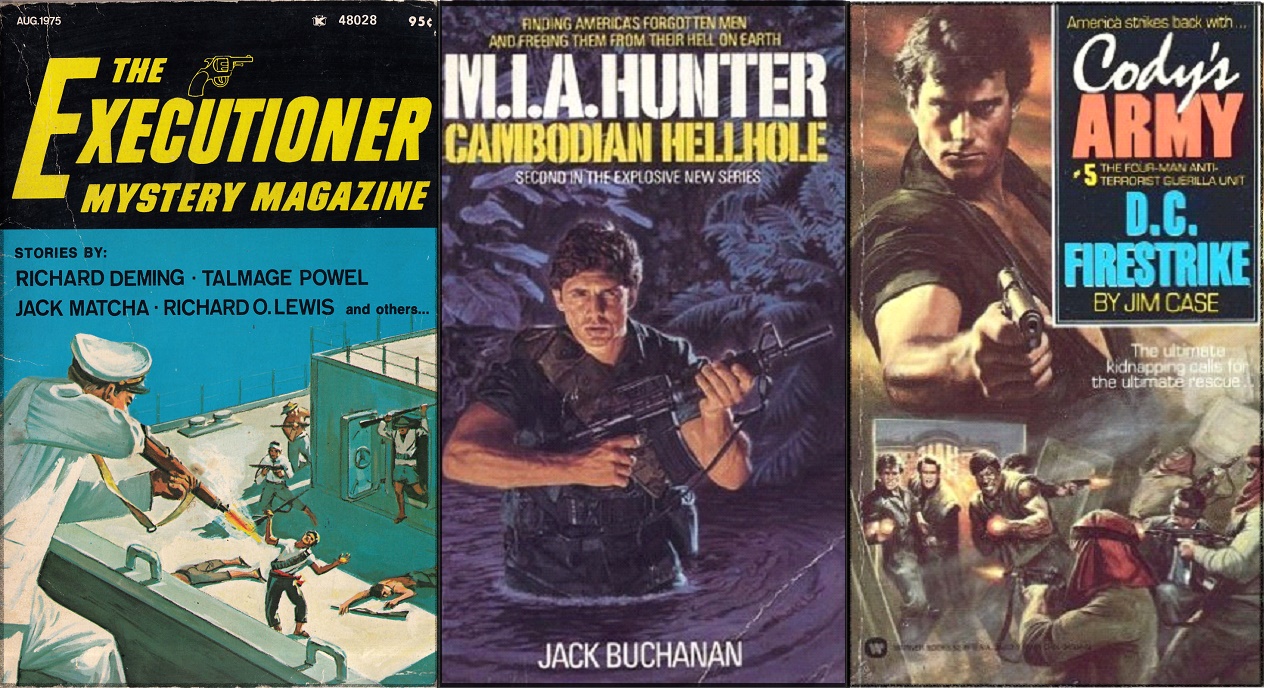

Your early career was spent writing men’s adventure fiction; The Executioner, and your own M.I.A. Hunter and Cody’s Army.  Were there any particular pleasures or displeasures of writing these types of books?

And let’s not forget The Tunnel Rats! The greatest pleasure was being able to practice the writing craft in anonymity while making money doing it. Because of course my name wasn’t on the Mack Bolan books; that was Don’s series. The other action/adventure books that I wrote were originally written under pen names. There are a variety of reasons that writers use pen names. You don’t want to be labeled in the popular or the editorial mind as a writer who only writes a certain type of novel, especially when you are as restless creatively as I am. It keeps you from being typecast. In a field like that, frankly, you are judged by the company you keep. There was Don Pendleton and one or two others but when I first broke into that field, even the established writers weren’t getting much respect. Not like today. So I thought it best to stay anonymous for that period of time. At the same time you’re delivering four to six books per year so you are honing your skills as a writer. It was a wonderful way to learn how to write. For instance, I wrote each of my first six action novels as a conscious nod to some writer who I felt influenced me and in that way I got it out of my system, to purge my writing of the sound of any other writer’s voice. I guess you could say that I arrived at my writing style through a process of exclusion. What was the displeasure? Having to meet deadlines.  Having to constantly work variations on the same formula. That generally applies to any sort of genre fiction. But all-in-all it was a good way to get started in the business.

Speaking of Don Pendleton, I know you are a great admirer of both him, as a person, and his work.  You have said his work was a direct descendent of what Mickey Spillane did with his hardboiled Mike Hammer novels and the pulp writer Carroll John Daly.  Would you expand on this idea?

I would refer anyone who’s interested in this subject to a book that came out back in the 1970’s called The Great American Detective, edited by William Kittredge and Steven M. Krauzer. It’s a collection of stories that trace the development of the fictional American Detective from the days of the dime novels and Carroll John Daly and it ends with the only Bolan short story that Don ever wrote. My point: the editors certainly saw Don in that tradition. The Introduction those guys wrote for that book presents the case more effectively than I could in an interview.

Are there any of Don Pendleton’s books you particularly admire?

Don’s major contribution is in creating the action adventure genre. Probably the most important lesson that I learned from Don was to consider yourself a serious novelist even if you are slanting your work for a genre market. I have tried to adhere to that and Don very much adhered to that in the sense that his Mack Bolan saga is character-driven, as in “serious” fiction. It’s character driven in the sense that Bolan is not the same person in the first book as he is in the last of Don’s original novels. It’s like one gigantic novel that came to us in a bunch of volumes. 

Then there’s one of Don’s last books, Copp in Shock; not his best, but one of my favorites. It’s a detective novel narrated by a private eye suffering from amnesia. Well, Don was enduring some challenging health issues at the time he wrote that one and in fact was suffering from severe memory loss. His wife, Linda, heroically assisted him. Of all the thrillers written about characters with amnesia, this is the only one I’m aware of that was written by an author recovering from amnesia while he wrote it!

Stephen Mertz (right) with Don Pendleton (left) and Richard S. Prather
I know you are a fan of the early pulp stories – your terrific short story “The Lizard Men of Blood River,” featured in The King of Horrors and Other Tales is an homage to the work of Lester Dent.  Are there any other pulp writers you particularly like?

There are writers who wrote for the pulps but aspired to greater things. There I am talking about Dashiell Hammett, Raymond Chandler and, for my money, Mickey Spillane. But then there were writers who only stayed in the pulp field. That’s all they wanted to do. That is what they did do. Those guys are mostly fun. That is the word you have to go with. If you measured them up against people I just named, most of them aren’t going to cut the mark…but then, who does? We’re in a Golden Age of pulp reprints so I don’t know what’s kept them from rediscovering Cleve F. Adams, a very funny hardboiled PI writer who wrote for the detective magazines in the 1930’s and ‘40’s. Of course, pulp writing is always with us. When the magazines faded away, pulp fiction just moved over to paperback novels. I’d have to go to the 1950s-60s for my second favorite unknown and that is Ennis Willie. I helped edit a collection of his work that Stark House published. It’s great hardboiled tough guy stuff.

Your later work, starting with Blood Red Sun (1989), is more ambitious than your earlier work. What, as you see it, is the major difference between writing the more formulaic adventure novels of your past, and these bigger and more robust novels you have been producing over the past few decades?

Well, they’re more fun to write for one thing and I hope that translates into the fact that they are more fun to read. I am not reinventing the wheel. I am falling back on things I learned writing pulp fiction when I write the more ambitious novels.


Blood Red Sun was published by Diamond Books, which was a publishing house started by Warren Murphy. Did you work directly with Mr. Murphy during its publication, and if so, what was the experience like?

No, I never had any contact with Warren. He was sort of the money guy there.  We did cross paths a couple of times years later. I worked with some editor. I forget his name. What I was trying to do with Blood Red Sun: that was my first book where I really stretched out and tried to say something and tell a tale that hadn’t been told before. I mentioned earlier, Hammett and Chandler. I was trying to do what they did and that was to take genre fiction and lift it into something that had broader scope and appeal. That is what I was trying to do with Blood Red Sun: take the tropes of action/adventure and honestly tell a story that could really have happened. 

Blood Red Sun, The Korean Intercept (2005), andDragon Games (2010) are set in Asia; World War II Japan, North Korea, and China, respectively. Does the Asian continent hold any special interest for you?

Well yes, but no more so than, say, the Middle East. The primary engine for fiction has got to be conflict and normally that is personal conflict, but you take entire cultures in conflict and, man, you are really working with something there. If you look at the history of those regions you just named and the culture of those countries and you stack that up side by side with the American way of looking at things, rarely if ever will they connect or even brush into each other. So in terms of being a novelist, there’s a lot to work with. And plus, let's face it, Asian chicks are hot.

You have written two novels, Fade to Tomorrow (2004) and Hank & Muddy (2011), which are set in the music world. In the Afterword of The King of Horror & Other Stories, you wrote that you performed as a professional musician – vocals and harp (harmonica) – for seven years:  Do these titles hold any special meaning for you since they are centered around music and musicians?

Oh, very much so. I think Hank & Muddy is the best novel I’ve written thus far, although it is certainly not cool to admire one of your children more than another. But still, music just flows through me. In fact, most of the years I was writing my early pulp fiction I didn’t write with any photograph or icon of any writer near me for inspiration; I had a picture over my desk of Chuck Berry doing the duck walk. The music we listen to says so much about us. Just like the food we eat and the movies we watch and the clothes we buy.

Hank & Muddy is a fictional imagining of Hank Williams and Muddy Waters meeting in Louisiana in 1952. The narrative is loaded with biographical information of both men. What type of research did you do?

This one pretty much ties into the last question. I’ve been listening to what they today call roots music since I was in high school. The Rolling Stones opened the door to a lot of us kids to what the blues was and soul music and everything else. So really the research for that book, I never really sat down and researched that one. I seem to remember almost every liner note and every musician’s biography that I’ve ever read. It was my long suffering mother who once observed that if I could only remember my multiplication tables as well as I remembered who played bass on Chuck Berry records, I’d be a brilliant mathematician. Mom, rest her soul, was right. I’ve been living music and writing since the day I found out about either one. I guess it’s inevitable that each would influence the other.

The title story in The King of Horror & Other Stories features a bitter writer who is no longer able to sell his work. In your Afterword you wrote it was an “open letter” to your friend Michael Avallone who had similar difficulties at the end of his writing career. Mr. Avallone had a wild reputation of self-promotion and an uncanny ability to bring others to anger. Do you have a story or two about Michael Avallone you would be willing to share?

I not only loved Michael Avallone but I also loved his wife, Fran, who was a great woman. She was everything that someone who loves a writer should be. I’ll always remember visiting them at 80 Hilltop Boulevard in East Brunswick, NJ. Fran cooked up a fantastic Italian dinner; this would have been 1983. Mike was pretty much in the state that you just mentioned.  He and I were sitting in his office which was within easy earshot although not within view of the kitchen where Fran was slaving over a hot stove. Mike went on about his travails, the challenges that were facing him and any number of complaints. He went on and he went on and he went on. I loved every word and I loved every minute of it. But I have a clear memory of Fran periodically calling up to us, “Michael, shut up and listen!” I am happy to report that Michael did not, could not, heed her advice. I walked away the richer for it.

Stephen Mertz (left) and Michael Avallone
Your more recent work has a quiet humor to it.  An example is Kim Jong-II using terrified prisoners as personal barbers in The Korean Intercept. Was this imaginary on your part, or is there some truth to it?

No, that was my sick imagination running rampant through my fingertips. By all accounts, the guy was totally bugfuck. You have two ways to look at that when you’re portraying it: you can either shake your head and let it happen or you can try to pull something out of it. It seems that if the guy was going to be crazy, he would be crazy in every department, not just in what he was doing to his own people but also getting a haircut. He was probably no fun to go shopping with. 

You wrote two dark suspense novels, Night Wind (2002) and Devil Creek (2004), which are different from anything else you’ve written. They both have significant elements of horror, suspense, and even a touch of romance. These novels, to me, showcase your range as a writer.  Would you tell us a little about these books?

Actually, when we get to the novels and stories published under my own name, nearly every one is different from anything else I’ve written. That’s my restless nature. I bore easily. I develop a story about people when I feel compelled to do so and when I’m finished writing that novel or story, I’m ready to move on; meet new people and write new stories. I think that is probably the overriding aspect of my work over the past fifteen years. Most of the novels are different from each other. The main similarity is that I wrote them. The idea for Night Wind had been in me since I moved to a remote rural area in Arizona. There’s no convenience store, no stop lights. The old joke is that Welcome and Come Again are on the same sign. When I first moved here thirty years ago, I was keenly aware that I was an outsider. Now I can spot an outsider right off. But feeling the way I first did, that if terrible crimes were suddenly committed right after I’d just moved here, good people would be well within the realm of reason to suspect that I, the unknown newcomer, had something to do with it . . . that’s the plot.

Funny story about Night Wind. One evening I had dinner with Joe Lansdale and a friend of his, Dean Koontz. Dean had just written a book, How to Write Best Selling Fiction. I had never read any Dean Koontz but after meeting him, I bought that book. It’s probably the best book about commercial writing that I’ve ever read. I perused that book meticulously. Then, still without reading any of Dean’s novels, I wrote Night Wind. People still come up to me after reading that one and say, “Hey, that reminds me of reading a Dean Koontz novel!"  Considering Dean’s enormous success, I’ve decided to interpret that as a compliment.

Do you have plans to write any other dark tales?

I will let you know when I get there.

You have been very prolific in the past few years. You have published a handful of novels, including creating a new adult western series called Blaze! Would you tell us a little about the series, and its genesis?

Now we’re back to the latest medium for pulp fiction. I created that series to establish a presence in the digital reading world; a series was the best way to go, so I worked a twist on the western genre that I’d never encountered before. Its genesis is a short story I wrote called “Last Stand,” which introduces a pair of gunfighters who are the two fastest guns in the West…who just happen to be married to each other. Kate and J.D. Blaze. I couldn't get away from the idea that those two deserved more than one story. I am happy to say that Rough Edges Press felt the same way and, in fact, wanted to amp up with a bi-monthly publication schedule. I’m too slow a writer to accommodate that, so a handful of topnotch writers stepped in to maintain consistent scheduling. They’ve just published Book #10 and presently there are enough books in the pipeline to get us through the year. J.D. and Kate. She’s a little smarter than he is but dog-gone-it, J.D. is a standup gent. They banter back and forth in between shooting the bad guys and sorting out various marital issues. These are western tall tales for today’s audience.


J.D. stands for Jehoram Delfonso.  Where did you come up with such an awkwardly intriguing name?

Well, it’s method writing. You try to be the guy, y’know? Would you want to be called Jehoram Delfonso, or J.D.? I know I'd prefer J.D. Jehoram is a warrior king in the Old Testament. At least once per book, Kate gets so mad at J.D. about something that she’ll call him by his given name in public. She’s the only person alive who has ever called him that besides his mother.

Many of your early works have appeared in eBook format over the past few years and you have several new titles that are primarily available as eBooks – Sherlock Holmes:  Zombies Over London, the Blaze! series. EBooks have seemingly opened new markets for many writers. What are your thoughts about eBooks, and how have they impacted your career?

It doesn’t make sense not to write for the digital market. Writers write to be read and these days that’s where the action is. It’s an exciting time to be a writer. I’m reminded of the 1950s. From what I know of the history of those years in popular writing, between the invention of the paperback novel, the advent of television, and comic books, all of a sudden there were all of these new ways to make money writing but everyone was still trying to figure out just how.  It was a wild frontier. That’s the way it is now. The M.I.A. Hunter series has gotten a second life. The new novels likeDragon Games and Hank & Muddy are doing well as eBooks. It’s a mixed blessing. As a reader, I prefer to sit under a light with a real book in my hands but as a writer, I’d have to say that much of my writing income today comes from eBook sales. So, it’s hard to be less than happy about success.

Speaking of eBooks, you did an interview with the blog Glorious Trash in 2013 and hinted there may be new M.I.A. Hunter novels appearing as eBooks. Is this still a possibility, or have you moved away from the idea?

No, it’s actually already happening. I’ve written a new Mark Stone, a reboot set in the present. Also, years ago when we were both hungry young lads, Joe Lansdale and I collaborated on three M.I.A. Hunter books.  They’ve just sold out aSubterranean Press hardcover omnibus of those so they’re now available in eBook format and trade paperback. Bonus material is included in the new editions to take readers behind the scenes of the development of the novels.

I heard this question in an interview on a BBC program a few years ago. If you were stranded on an island and you had only one book, what would it be?

Well, of course, we all have our favorite novels but once read, the great ones are remembered.  I’d have to cheat. I snuck in two. If I was looking at eternity all by myself on a deserted island and wanted entertainment, wisdom, and to stay in touch with the universe beyond the end of my nose, reckon I’d pack along a Bible and The Collected Plays of Mr. Shakespeare.

 The opposite side of the coin. If you were allowed only to recommend one of your novels, or stories, which one would you want people to read?

Hank & Muddy. That one just has a life of its own. I love that book and I hope I write a few more that are as good.

Thursday, April 07, 2016

Forgotten Books: MURDER AMONG OWLS by Bill Crider

MURDER AMONG OWLS by Bill Crider


The only series I read regularly are those that offer worlds I want to visit. This may be because before I began reading mysteries reguarly I read science fiction. World building is critical in sf and fantasy.

And it is in mystery fiction, too. Sherlock Holmes. Agatha Christie. John Dickson Carr. Indelible worlds. Or Mr. and Mrs. North. Craig Rice's various detectives working out of Chicago. Hammett, Chandler, Chester Himes' Harlem novels.

And Bill Crider's small town Texas series, the latest of which is MURDER AMONG OWLS.  This time Sheriff Dan Rhodes has to decide whether Helen Harris' death was accidental or criminal. At certain points in his investigation his deputies are his biggest hindrance to solving what is now clearly a crime. Wizards they're not.

Any novel that references the Warner Bros. cartoon icon Pepe Le Pew on the third page is a can't miss reading exprience for me. And Crider does this as he does everything else--nice and easy. The sentences and the scenes flow so gracefully you might overlook the difficulty of keeping the writing so spot-on.

If you think Andy Griffith of Mayberry with an edge and a tart tongue you'll have a good sense of of the world Crider creates in these fine books. He's admirably unsentimental about his town and its people, seeing them for what they are. The good ones are good without being saints, the bad ones are bad without being Hannibal Lechter. Real people doing real people things.

Two highlights--the dog who's scared of the cat and a hilarious chain saw chase between a lunatic and his seventy-something would-be prey. I've never read this scene in any form anywhere else before. It is pure Crider and the essence of his best work.

You'll like Rhodes and his town. And for sure you'll want to come back for more.

Wednesday, April 06, 2016

Bill Pronzini on Elliott Chaze


Ed here: Bill Pronzini's contributions to the genre of crime fiction have been enormous. First he created the groundbreaking Nameless series (stronger than ever) second he wrote numerous stand-alones and stories that have won praise and awards world-wide and third he has compiled a body of excellent literary biography and criticism that needs to be collected and published. Here is an example from Mystery*File.

ON ELLIOTT CHAZE
by Bill Pronzini


Elliott Chaze (1915-1990) was an old-school newspaperman who began his journalism career with the New Orleans Bureau of the Associated Press shortly before Pearl Harbor, worked for a time for AP’s Denver office after paratrooper service in WW II, and then migrated south to Mississippi where he spent twenty years as reporter and award-winning columnist and ten years as city editor with the Hattiesburg American.


In his spare time he wrote articles and short stories for The New Yorker, Redbook, Collier’s, Cosmopolitan, and other magazines, and all too infrequently, a novel. In an interview he once stated that his motivation in writing fiction, “if there is any discernible, is probably ego and fear of mathematics, with overtones of money. Primarily I have a simple desire to shine my ass — to show off a bit in print.”

His first two novels were literary mainstream. The Stainless Steel Kimono (Simon & Schuster, 1947), a post-war tale about a group of American paratroopers in Japan, was a modest bestseller and an avowed favorite of Ernest Hemingway.

The Golden Tag (Simon & Schuster, 1950), like most of his long works, has a newspaper background, contains a good deal of autobiography, and is both funny and poignant; it concerns a young wire service reporter and would-be novelist in New Orleans who becomes involved with two women, one of them married, while reporting on a sensational murder case.

His third novel was the one for which he is best remembered today, Black Wings Has My Angel (Gold Medal, 1953; also published as One for My Money, Berkley, 1962 and as One for the Money, Robert Hale, 1985).


for the rest go here:http://mysteryfile.com/blog/?p=142

Tuesday, April 05, 2016

Gravetapping: Reading Ed Gorman


"The Autumn Dead, with its depth, its heartbreak, and its melancholy hope, is
a new and important kind of American mystery."
Dorothy B. Hughes

Ben Boulden:
This is an introduction I wrote for the Stark House omnibus edition of Ed Gorman’s fine novels, The Autumn Dead and The Night Remembers, published in December 2014. The Autumn Dead features private eye Jack Dwyer and The Night Remembers features private eye Jack Walsh. The Stark House edition is still available, and all of the novels—both Jack Dwyer and Jack Walsh—are available as bargain priced ebooks. There are links to each novel’s Amazon page at the bottom of this essay.  

Ed Gorman is an unheralded writer of uncommon ability. He is a writer with a conscience—his characters reflect the world and he has an uncanny ability to make them sympathetic—but he is also an immensely entertaining storyteller. Mr. Gorman’s work has ranged wide, but he is particularly good at the first person detective story and two of his best are collected in this omnibus: The Autumn Dead and The Night Remembers.

In 1985 Ed Gorman, in his second published novel, introduced his first private detective, Jack Dwyer. Dwyer is a former cop who got the acting bug after being cast in a local public safety commercial. He started acting lessons, quit his job, applied for his private investigator’s license, and took a security job to keep the wolves away. Jack Dwyer appeared in five novels and The Autumn Dead is the fourth.

The Autumn Dead is the definitive Jack Dwyer novel. It fulfills the potential and promise of both Dwyer as a character and Ed Gorman as a writer. It is a richly detailed detective novel strong on story and scored with a thought provoking working class commentary. Jack Dwyer is the principal instigator of the novel’s action, but he is also a spectator of the melancholy and hard world he inhabits. He is not a saint, and is unable to right many, if any, wrongs, but he notices the humanity around him. More importantly, he understands humanity in all its beauty, frailty and brutality. In an early scene from The Autumn Dead,Dwyer describes a housing development built in the 1950’s.

“They’d built the houses in the mid-fifties and though they weren’t much bigger than garages, the contractors had been smart enough to paint them in pastels—yellow and lime and pink and puce, the colors of impossible flowers, the colors of high hard national hope—and they were where you strived to live in 1956 if you worked in a factory and wanted the good life promised by the Democrats and practiced by the Republicans.”    

It is a neighborhood forgotten by time and left to crumble and tarnish new generations with a hard scrabble existence. It is a place where dreams die, girls become hard and old before they reach maturity, and a place where the lowest rung of humanity struggles to survive. In the novel this hopelessness and poverty is juxtaposed with the comparatively well off.  The professional classes and the downright wealthy. Dwyer is unable to claim membership in either class—he was raised in one and has never been able to fully gain access to the other. The conflict of class is personified by an old classmate and friend named Karen Lane.

Karen seemingly escaped her childhood poverty, but she gave herself away in the attempt. She is described much like Truman Capote’s Holly Golightly. She is a woman-girl desperately trying to erase her own bitter world with her sex, and while her surroundings changed, for a time at least, she was never able to completely overcome the poverty of her childhood. A passage describing Karen’s borrowed room in the home of a friend captures the rub between the dream of something more and reality.

“The clothes—fawns and pinks and soft blues and yellows, silk and linen and organza and lame and velvet—did not belong in the chill rough basement of a working-class family. There was a sense of violation here, a beast holding trapped a fragile beauty.”           

There is a bitter melancholy in much of Ed Gorman’s work and The Autumn Dead is no different. It is a narrative of loss and disappointment; the loss of time, the slow crawl to death, and the disappointment of failure.

“‘You know what his problem is?’

“‘What?’

“‘He isn’t a boy anymore.’”   

In 1991, Ed Gorman introduced his second private eye, Jack Walsh, in The Night Remembers. Jack appeared in only one novel, and while he would have made a wonderful serial character, his story is seemingly complete in a single volume. Jack is 62, a World War II veteran who fought at Salerno, a retired cop—Linn County Sheriff’s Department headquartered in Cedar Rapids, Iowa—and a live-in manager of a rundown apartment building in a decaying neighborhood. Jack operates a one man private investigation shop, smokes six cigarettes a day and has an on again off again relationship with a woman nearly half his age named Faith Hallahan.

Faith is a major player in both the novel and Jack’s life. She is the mother of an 18-month old boy named Hoyt—she claims Jack is the father—and Faith is nearly certain she has breast cancer. Faith, like many of Mr. Gorman’s female characters, has a gentle sadness, an almost broken quality, about her. She is described with an intimate fondness.

“[R]egal, imposing, and, even at times such as these, a little arrogant. The hell of it is—for her sake anyway—she’d had one of those terrible childhoods that robbed her of any self-confidence her looks might have given her. ‘I’m only beautiful on the outside,’ she’s fond of saying in her dramatic way.”

Amazingly Jack takes Faith’s indecision about their relationship in stride. He truly loves Faith and Hoyt. There are several tender scenes between the three, which develops a visceral intimacy. Jack has an indistinct role in Faith’s life. He is a mixture of father, priest and lover, which summarily describes his outsider role in society.

Jack’s personal strife is a backdrop to the mystery, but it is an important and rewarding element because it focuses an understanding of his viewpoint, and it is Jack’s view of the world that shimmers in the narrative. It is offhand references to real world people like Lyndon LaRouche, George McGovern and Jimmy Carter—“…Carter I never could stand. Maybe it was that psychotic smile.”—and the sympathetic brush Mr. Gorman paints his characters with that pushes the novel beyond. He is particularly good at capturing a mood, a sorrow, an ill, in a few simple, sparse sentences.

“The little girl watched me as I started down the stairs. She looked sadder than any child her age ever should.”

In another scene, a rambling bigot who justifies his hate with religion, is described with a keen sense of understanding—or maybe pity—without allowing for credibility or justification of the hate.            

“In his plaid work shirt and baggy jeans and house slippers, he looked like the sort of melancholy psychotic you saw roaming the halls of state mental institutions just after electroshock treatment, the pain and sorrow only briefly dulled by riding the lightning.”

Jack, like Dwyer, is an observer of a world he doesn’t quite understand, but a world he has a wistful empathy for. A world filled with desperate, scared people behaving in ugly and malicious ways, but allowances are nearly always provided. Small understandings, if not always completely satisfactory, are conveyed in the narrative explaining the ugliness.   

“She enjoyed making you despise her. I suppose she hoped that somebody would despise her almost as much as she despised herself.”  

The Night Remembers and The Autumn Dead are similar—first person narrative with a sentimental, intelligent, and watchman-like protagonist—but beneath the surface both are very different novels. The Night Remembers is a wistful, sentimental novel filled with betrayal and an exhausted weariness while The Autumn Dead is very near angry. The novels are both dark, but there is humor. Jack Dwyer is a self-deprecating wise-ass. There is a Jim Rockford moment in The Autumn Dead when a bartender wants five dollars to tell Dwyer where he can find a man.

“‘It worth five bucks to you?’

“‘That’s only in the movies. Just call Chuck.’

“‘I need some grease to do it because I got to walk all the way down the basement stairs. The intercom is on the blink.’”

Jack Walsh is less smart-alecky than Dwyer, but the humor pops up unexpectedly—the reference to Jimmy Carter’s “psychotic smile” and an exchange between Walsh and the owner of the building he manages. A man he refers to as “young Mr. Banister.” His description of Banister is one of the highlights.

“He was approximately thirty-five with a short earnest haircut, black earnest horn-rim glasses, an earnest white button-down shirt, an earnest blue five-button cardigan sweater, and a pair of earnest chinos that complemented his very earnest black and white saddle shoes. It was the wrong sissy touch, those shoes on a man his age, and told me more than I wanted to know about young Mr. Banister.”

Jack Walsh also appeared in the 1990 short story “Friends,” but he was disguised under the name Parnell. The primary backup players were there—Faith and Hoyt—and the story is worth finding. Jack Dwyer appeared in five novels, New, Improved Murder (1985),Murder in the Wings (1986), Murder Straight Up (1986), The Autumn Dead (1987), and A Cry of Shadows (1990), and three short stories, “Failed Prayers” (1987), “The Reason Why” (1988), which is the basis of The Autumn Dead, and “Eye of the Beholder” (1996).

Monday, April 04, 2016

Antiques Fate by Barbara Allan


     "In my rendition, I play all the parts in a sixty minute condensation of my own creation. Shakespeare was a good writer, but he runs to the long-winded and needs occasional editing."
  The speaker here could only be Vivian Borne aging bi-polar diva (and antiques expert) and mother of Brandy Borne (co-owner of the family antique store back in Serenity, Iowa), long suffering thirty-two year old daughter who must follow her mother around to keep her out of amateur theater trouble but also murder trouble. Vivian does love a mystery.
   Antiques Fate is, for me, the funniest yet in the series. As usual Brandy narrates and spends a fair share of the time directly addressing the reader:
   "Yes, we were a pill-happy little group--lithium for Mother's bi-polar disorder, Prozac for my depression, and insulin for (shih tzu) Sushi's diabetes."
   When a  New York troupe has to cancel because performing "Macbeth" at a weekend festival at town that celebrates its its carefully crafted resemblance to a quaint English village, Vivian steps in as a substitute. She will perform all the roles herself, changing hats each time she changes character. Simply by changing hats the audience will be able to identify who each character. Is Vivian ever wrong?
   The village of Olde York is having problems. Some of its citizens want to modernize it and some want to leave it as it is. Feelings run deep and dangerous as Vivian and Brandy discover when people start to die.
   I really like the writing here. For all the humor Barbara Allan (husband and wife Barbara and Max Allan Collins) are able to create not just suspense but numerous ominous scenes especially inside the theater. The past here has rotted; there is an almost decadent gloom among those work operate it.
  Vivian remains the star of course as she bulldozes her way into disinterring old secrets that ultimately lead to the true murderer (several enticing suspects.)
   Five star fun. I can't wait for Vivian to drive all of us crazy again.

Sunday, April 03, 2016

Shadow Games and Other Sinister Stories of Show Business available for pre-order!

Shadow Games and Other Sinister Stories of Show Business available for pre-order!

"Shadow Games is a page-turning, gut-wrenching barnburner of a book."—Robert Bloch


Ed here: My first cousin Bobby Driscoll was a major child star of the late 1940s and early 1950s. He died at thirty of drugs. While I don't use any of Bobby's life in this novel I do look at child stardom here. Theses a slightly revised edition of Shadow Games (1992) which I wrote at the time I was writing scripts for  two different directors and learning a little about the ways of Hwood. 


Cover art © by JT Lindroos

"Shadow Games unflinchingly examines the dark side of humanity and reaches a finale that is both moving and terrifying."
—Ramsey Campbell


"What keeps you reading is not the traditional question of whodunit but the slick and artful ease with which Gorman portrays the alienated, uncaring world of his creation."
--The London Sunday Times

Cobey Daniels had it all. He was rich, he was young and he was the hottest star in the country. Then there was all that messy business with the teenage girl . . . and it all went to hell for Cobey.

But that was a few years ago. Now Cobey's pulled his life together again they're letting him out of the mental hospital and he's ready for his big comeback, but the past is still out there, waiting for him. Waiting to show Cobey a hell much more terrible than he could ever have imagined.

The American 90s come brutally alive: "Gorman knows how to shunt electricity into the raw nerve endings buried far below the reader's already clammy skin."
—Locus

© Ed Gorman


PRAISE FOR SHADOW GAMES

"Ed Gorman's is a strong and unique voice."
—Richard Matheson

"(Gorman) should be required reading for anyone who wants to experience the art of the short story as practiced by a master craftsman."
—Mystery News

"Gorman is the poet of dark suspense."
—The Bloomsbury Review

"John D. MacDonald meets Jim Thompson in a maelstrom of malicious evil and perverse maipulation that doesn't let up until the final few pages...thoughtful, tightly knit and elegantly structured."
—Million (UK)

"This is a bleak moral tale but written with such hot feeling and such cool style that it entertains even as it keens."
—Morning Star (UK)


Title Details:

RRP Price: £11.95
Publisher: Short, Scary Tales Publications
Release Date: May 1, 2016
ISBN: 978-1-909640-52-8 (6" x 9" Trade Paperback)
First Edition
Pages: 354


This brand new edition is available for pre-order from the Short, Scary Tales website. The first 100 copies sold direct from the site will be signed by me and the cover artist, JT Lindroos!


Thursday, March 31, 2016

Forgotten Books: The Crimes of Jordan Wise, by Bill Pronzini.


The Crimes of Jordan Wise, by Bill Pronzini.

Actuary Jordan Wise tells a joke on himself a third of the way through the novel: (paraphrase) an actuary is somebody who doesn’t have the personality to be an accountant.

If you watch many true crime shows, you see a lot of Jordan Wises. People who fall into crime through circumstance rather than those who go looking for it.

Jordan becomes a criminal only after meeting Annalise, a troubled and very attractive young woman who needs two things badly – sex and money. But in order to get the sex on a regular basis, Jordan must first provide the money. He embezzles a half million dollars and flees with Annalise to the Virgin Islands. In this first part of the novel, there’s nice James M. Cainian detail about how Jordan comes alive for the first time in his life. Some of this is due, whether he admits it or not, to the danger of committing a serious crime. But most of it is due to Annalise and his profound sexual awakening.

The central section of the book reminds me of one of Maugham’s great South Seas tales – lust, betrayal, shame played out against vast natural beauty and a native society that, thanks to an old sea man named Bone, Jordan comes to see value in – even if Annalise, her head filled with dreams of Paris and glamor, does not. Old Maugham got one thing right for sure – as Pronzini demonstrates here – a good share of humanity, wherever you find them, is both treacherous and more than slightly insane.

There are amazing sections of writing about sea craft and sailing that remind me not of old Travis McGee but of the profoundly more troubled and desperate men of Charles Williams who find purity and peace only in the great and epic truths of the sea. That they may be as crazed and treacherous as everybdy else does not seem to bother them unduly.

There are also amazing sections (almost diaristic sections) where Jordan tells of us his fears and desires, his failings and his dreams. In places he deals vididly, painfully with his secret terror of not being enough of a man in any sense to hold Annalise.

The publisher calls this a novel and so it is. Pronzini brings great original depth to the telling of this dark adventure that is both physical and spiritual. He has never written a better novel, the prose here literary in the best sense, lucid and compelling, fit for both action and introspection.

You can’t read a page of this without seeing it in movie terms. The psychologically violent love story played out against a variety of contemporary settings gives the narrative great scope. And in Jordan Wise and Annalise he has created two timeless people. This story could have been set in ancient Egypt or Harlem in 1903 or an LA roller skating disco in 1981. As Faulkner said, neither the human heart nor the human dilemma ever changes.

Wednesday, March 30, 2016

BACKSHOT: 2012 by Tom Piccirilli from Gravetapping

Posted: 29 Mar 2016 02:00 PM PDT


Ben Boulden:

Backshot: 2012is the second of two related novellas. 2012was written by Tom Piccirilli and Backshot:1902 was written by Ed Gorman. The connection between the two is Marshal Delmar Royce who is a minor, but key, player in the latter parts of 1902 and the great3-grandfather of 2012’s antihero, Royce.

Royce is a professional thief lying in a hospital bed with a broken back and useless legs. His lifelong friend and partner, Quill, punched a bullet in his back after their last job and now Royce is looking at a painful future and a five-year prison stretch. The doctor tells him he won’t walk for a year, but Royce is on his feet in six months; it’s another three years before his release from prison and his planned revenge against Quill.

2012is a touch Richard Stark, but wholly Tom Piccirilli. The plotline is Stark—Royce is betrayed by his partner and spends the rest of the story getting even—but it is stylistically and thematically Piccirilli. Mr. Piccirilli’s literate, smooth, stark style is, perhaps, the finest in modern crime fiction—

“DeKooning sighed. It was the sigh that said you couldn’t believe people were so clichéd, so obvious, so average. You heard the story a thousand times before and here it was again, and you just couldn’t believe you were going to have to sit through it one more time. DeKooning frowned. It said more about him than anything before.”  

It is thematically complex with a heaviness of the past’s influence on the present. Royce is haunted by the image of a man he will never meet, Delmar Royce, and Quill is tormented by the shadow of his abusive father. The story never strays into predictability, and Royce is, if not exactly likable, understandable and even familiar.

Tom Piccirilli died in July 2015 from brain cancer. He was a talented writer who started his career in horror and then migrated to crime. He won multiple Bram Stoker awards for his horror fiction, including best novel for The Night Class, and he won the Thriller Award for best paperback original for his crime novels The Midnight Road and The Coldest Mile. Backshot: 2012 was published posthumously, and as I read it, I wondered if it is the last of Mr. Piccirilli’s original work.   


Tuesday, March 29, 2016

Heart and Soul Pt. 2 March 29th, 2016 by Max Allan Collins

Heart and Soul Pt. 2

March 29th, 2016 by Max Allan Collins

Parody cover courtesy of Gene Eugene


The week I spent on the fifth floor – the rehab area – I remember clearly. The days weren’t bad, with Barb again visiting me from late morning till early evening, and bringing me in real food for lunch. Every day had me receiving a mildly demanding schedule, with O.T. (Occupational Therapy) and P.T. (Physical Therapy) sessions every morning and afternoon.
P.T. concentrates on the waist down, getting you walking again, building your strength up, utilizing such things as parallel bars, stationary bikes and a little flight of stairs. The P.T. trainers tended to be young, several of them working on their grad degrees. The one in charge was an attractive blonde named Tessa who had a deadpan sense of humor that Buster Keaton might have envied (not that Tessa would have any idea who Buster Keaton was). She took voluminous notes on her laptop while her grad school charges worked with me, and I accused her of moonlighting on a blog, which I speculated was called “Fit to Fit,” concentrating on fashion tips for the gym.
Another young woman, one of the grad students (whose name I unfortunately don’t recall), attempted to teach me how to get into and out of bed, without disturbing my chest incision (a big concern at the hospital). She demonstrated easily, using her abs since you’re not allowed to push up on your hands. I asked her how old she was, and she said, “Twenty-two.” Then I asked her how much she weighed, and she said, “One-hundred twenty.” I said last year I’d eaten 120 pounds of doughnuts.
The O.T. trainers who I worked with were all women, of various ages. The youngest, in her early twenties, had never heard of Bela Lugosi. I don’t remember how that came up, but she also had never heard of Boris Karloff. Nor Vincent Price. A somewhat older young woman was passing by, and I asked her about Lugosi and Karloff, and she’d never heard of them either. She did know Vincent Price, and explained to the younger woman that he was “the guy at the end of ‘Thriller.’”
O.T. concentrated on my hand, putting me to work with a Silly Putty-like substance and having me insert tiny pegs into slots. Early on we discovered I had lost my signature and could not use a computer keyboard. But we stayed at it.
One of the things various O.T. females did was guide me through my morning shower. This embarrassed me for about ten seconds. I looked like forty miles of bad road and humiliation was a way of life by now. The point was to demonstrate that I could do my own showering and such without help, or anyway much help. I did this pretty well, despite my dislike of showers (also, I had to sit on a bench in there). My funky right hand had me using my left for shaving, at first, but shortly I began forcing myself to use the right for that (electric razor, not straight razor!) and started brushing my teeth with my right hand as well. A big part of getting my hand back (I’m at about 80% now) has been forcing the right hand to do its work, as with eating utensils.
The bathroom had an oddity that I still can’t figure. The sink was narrow and long, putting way too much distance between your face and the mirror, making shaving very tricky indeed. I described this to one O.T. female as being like watching your neighbor across a courtyard shave out the window.
Another oddity, not in the bathroom, was the reclining chair in which a patient spent a lot of time, since the bed was so uncomfortable. The lean-back lever was incredibly hard to utilize – particularly for somebody who was not supposed to strain his chest incision. I think the guy who bought the sinks also bought the chairs. Musta got a deal.
Between the physical therapy sessions and my lovely wife’s presence, the days weren’t bad at all. Seeing Barb come in the door always lit up my world. But oh those nights, those endless, endlessly interrupted nights.
One of the worst began when my heart surgeon stopped by to ask about, well, my regularity since the surgery. It was a week since then and there hadn’t been any. He said cheerfully, “Well, we’ll hit it from both ends.” I will allow your imagination to help you interpret that, as well as spare you the discomfort and embarrassment that made that particular night the longest of all. But God bless the nurses who saw me through it.
The next day I was so weak and dehydrated that I couldn’t leave my room. The O.T. and P.T. people came to me and we soldiered on.
The last straw that led to Barb and me insisting on a release came on an even longer night. I was alternating short bouts of sleep with reading books and watching DVDs, and a nurse suggested that I take a sleeping pill.
A sleeping pill called Ambien.
Let me do a quick sidebar here, having to do with a gift my son gave me for Christmas, one of the best presents I ever received – a Blu-ray box from Japan of the complete COLUMBO in a cigar box. Fantastic! Barb and I, in the weeks preceding my surgery, watched a COLUMBO episode each evening.
Thus it was that during my hospital stay I dreamed my own brand-new COLUMBO episodes almost every night. Sometimes I was Columbo, sometimes I was the killer, other times I just watched. The most memorable episode was about identical twins who’d both had heart surgery and were sharing a room in the hospital. One brother sneaked out to kill somebody, and Columbo caught him because the two urine jugs in the room had both been filled by one brother.
Nate told me he doubted that would play very well on TV.
But you get the idea of the nature of my dreams in that place. Under the first-time influence of Ambien, I dreamed not of Columbo but of Miss Marple and her two talented nephews. Remember those great Christie characters? Me either. But they got themselves caught up in a gauzy European horror film right out of Dario Argento, with a serial killer slaughtering everybody left and right. I was suddenly in the midst of it all, trying to move through one sheer curtain after another while the killer pursued me.
Now understand that I was not allowed to get out of bed without assistance. That I was essentially in the process of learning to walk again. That I was required to ring for help to use the bathroom. Nonetheless, I apparently ran out into the hall, shouting, “Murder! He’s killing everyone! Murder! Save me!” I don’t think I fell down – I certainly had no signs of that, after – but I remember vividly being on the floor while a nurse bent down before me like she was giving a water bowl to her dog.
“Do you know where you are?” she asked.
“I’m not sure,” I said. “But I think I’m in Max Allan Collins’ room.”
Time to go home.
NEXT WEEK: HOME AGAIN HOME AGAIN
– – –
Check out the Wikipedia page for the QUARRY TV series.
And the official QUARRY series web site.
Speaking of Quarry, top writer Mike Dennis provides this great QUARRY’S VOTE review at his web site.
M.A.C.

Monday, March 28, 2016

Can't we all just get along? Actors who hate other actors

Ed here: There's a long list of these on Movie Morlocks today - here are some highlights. For the rest go here:

3. Joan Crawford on Bette Davis: “She has a cult, and what the hell is a cult except a gang of rebels without a cause. I have fans. There’s a big difference.”
4. Bette Davis on Joan Crawford: “I wouldn’t piss on her if she was on fire.”
5. Sterling Hayden on Joan Crawford: “There’s is not enough money in Hollywood to lure me into making another picture with Joan Crawford. And I like money.”
”
7. Carol Lombard on Vivien Leigh: “That f–king English bitch.”

19. Walter Mattheu to Barbra Streisand during an on set argument while making HELLO DOLLY!: “I have more talent in my farts than you have in your whole body.”

25. Richard Harris on Michael Caine: “An over-fat, flatulent, 62-year-old windbag. A master of inconsequence masquerading as a guru, passing off his vast limitations as pious virtues.”
26. Frank Sinatra on Shelley Winters: “A bowlegged bitch of a Brooklyn blonde.”
27. Shelley Winters on Frank Sinatra: “A skinny, no-talent, stupid, Hoboken bastard.”

28. John Gielgud on Ingrid Bergman: “Ingrid Bergman speaks five languages and can’t act in any of them.”
29. William Holden on Humphrey Bogart: “I hated the bastard.”
30. Humphrey Bogart on William Holden: “A dumb prick.”

These insults were compiled from various books, magazines, newspapers and IMDB.com.
Feel free to share some of your own favorite insults from classic actors below. I’m sure there are plenty more that I haven’t mentioned.