Friday, April 04, 2014

Matt Helm DEATH OF A CITIZEN from Gravetapping


Matt Helm - Death of A Citizen
Titan Books


Ben Boulden from Gravetapping: 

Matt Helm is a solid citizen.  He is married with three children.  He makes a living writing popular novels (western’s mostly), and lives with his family in Santa Fe, New Mexico.  His picture perfect American dream is mangled when Tina, an operative he briefly worked with in Europe during World War II, walks through the front entrance of a cocktail party.  She passes an old signal to Matt—“I’ll get in touch with you later. Stand by”—and in an instant (and without much fuss) Matt’s idyllic existence shatters.
Death of a Citizen is the first (of 27) Matt Helm novels, and it is absolutely terrific.  In the opening sequence Helm is an everyman; likable and stable with a pretty wife and a family, but it only takes a few hours for his old habits to take over.  It starts with a dead woman in his writing room, and then a confrontation with Tina who, after some convincing from Matt, weaves a fantastic story about a Soviet agent hunting a nuclear scientist working for the Atomic Energy Commission at Los Alamos.
The action is convincing, the prose is smooth and cool—
“Suddenly I was feeling fine.  You can stay tense only so long.  I was over the hump.  I was driving ten miles out of the way, with a corpse in the bed of the truck, just to take a worthless alley cat home.”
And the plot is as tight and smooth as a guy wire.  There is more than the usual backstory about Helm’s World War II exploits, and post war life, but it is done without interrupting the forward momentum of the plot.  Even better, Mac—the leader of the “organization” Matt worked for, and is once again working for—makes an appearance in the field, and Helm’s doubt and operational rust give him an element of believability. 
Death of a Citizen is the first of the Matt Helm novels, but it is as convincing, urgent, and well written as any of them.  In a sense it is the primer.  It introduces Helm, the organization, and everything it is, which is essentially a kind of counter intelligence wet work squad.  It is the cold war on a small field.  The best part, the citizen who lost his life (from the title) is Helm himself, and what he gains is a certain freedom, his code name Eric, and an outlet 

Thursday, April 03, 2014

RICHARD MATHESON ENTERS THE TWILIGHT ZONE


RICHARD MATHESON ENTERS THE TWILIGHT ZONE

lee-marvin-twilight-zone
Richard Matheson was already an established writer in 1959, the year he started contributing to The Twilight Zone. But it took him a while. Over the course of the 1950s he rose from pitching sci-fi magazines on his off hours as a mailman, to adapting his own material to screens large and small. He  sold his first story, “Born of Man and Woman”, to The Magazine of Fantasy and Science Fiction in 1950. After a couple of suspense novels fizzled, he garnered notice with his post-apocalyptic survival staple, I Am Legend (1954). It was his follow-up, The Shrinking Man (1956), that cemented his place in popular consciousness. He ingeniously sold himself as screenwriter as part of the film rights deal to Universal, and he would be a prolific writer for film and TV for decades to come (alongside his novels and short stories). As part of our week-long tribute to Matheson, following his death last month at the age of 87, I’ll be looking at the Twilight Zone episodes he declared to be his favorite, Steel and Night Call, both from Season 5. They present fantastical premises with procedural detail, as he also did with I Am Legend and The Shrinking Man, bringing the spectacular down to earth.

After the success of The Shrinking Man and its movie adaptation (which added Incredible to the title), Matheson moved to television writing, often with collaborator with Charles Beaumont. They were close friends, part of a circle of fantasy writers that included Robert Bloch, Ray Bradbury and Harlan Ellison. Matheson recalled that, “When we joined this agency [Adams, Jay and Rosenberg] it was such a strange new world out there that we decided to work together.” Beaumont and Matheson worked on cop shows and Westerns like Bourbon Street Beat and Have Gun — Will Travel.
Their most long-lasting contribution was to The Twilight Zone, which they both began contributing to, separately, in ’59. Rod Serling was a fellow traveler in the speculative arts, and provided an invaluable platform for the kind of material they wanted to write, even with showbiz compromises. Their material, as Matheson notes, “never made any social commentary”. They were detail men, interested in fleshing out their imagined worlds rather than allegorizing the existing one.
[hulu id=hk42kmjvs1h7ql9xizocvw width=512]
In Twilight And Other Zones: The Dark Worlds of Richard Matheson, the writer declares that “Steel” is his favorite episode of the ones he wrote. He adapted the teleplay from his own short story, of a “sports item, circa 1976″, in which boxing was outlawed and replaced by bouts between lifelike robots. Lee Marvin plays the “Steel” of the title, a former pug turned down-at-heel manager, too poor to upgrade his rickety “Battling Maxo” bot, which mechanic Pole (Joe Mantell) keeps running through some spit and a prayer. Maxo is so old even his parts are outdated, and is only booked when a newer model is destroyed in a car accident. Steel needs Maxo to put up a fight so he can pocket the take and make some upgrades. Matheson’s small-scale story was later inflated into the 2011 blockbuster Real Steel.
for the rest go here:
http://moviemorlocks.com/2013/07/09/richard-matheson-enters-the-twilight-zone/

Wednesday, April 02, 2014

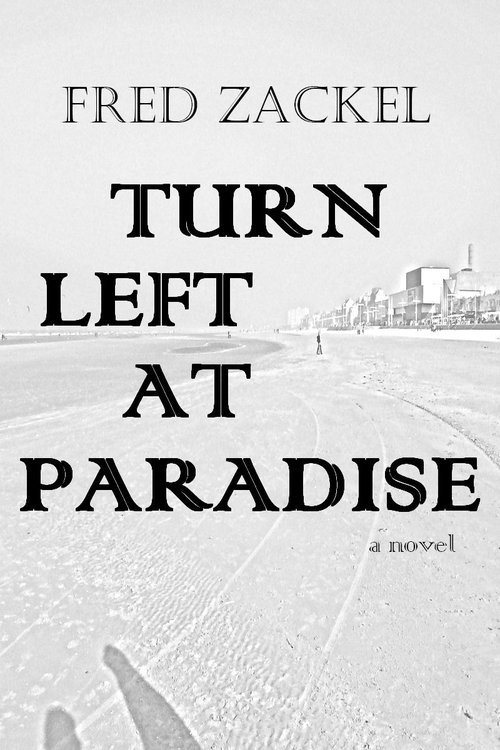
Fred Zackel's TURN LEFT AT PARADISE


FROM NOIR JOURNAL


Turn Left at Paradise, Fred Zackel’s latest thriller available on Kindle, has crime, gore, mystery – but is basically a family drama. Make that melodrama. This family is decidedly dysfunctional.
Bobbie Kelly spent his life without coming to grips with spiritual challenges buried deep inside. That was before his massive heart attack. Now, facing mortality, his past haunts him – in the figure of his long-dead brother, Patrick.
He “escapes” ICU and flies back to the home of his childhood to right the old wrongs and give his soul a chance for at least Purgatory. He feels Paradise may be too great a hope.
Home was Cleveland, Ohio, and a massive blizzard greets him on his return after a gap of thirty-eight years. Weather becomes a character in the story. It’s bitter. It’s wicked. And with Zackel’s vivid prose, it chills the bones of the reader.
The weather is a total shock to Max Kelly, San Francisco police detective, who follows his father on this runaway trip. He – nor anyone from the past – quite understands Bobbie’s driven need to revenge his brother’s death and save his own soul.
Bobbie, ever pressured by the persistent presence of the ghost of his murdered brother, digs up bones, re-opens old wounds and brings chaos and death to lives that had quietly suppressed the past. His brother Patrick was a cop. Now old, retired cops, possible witnesses and family connections are dying as the killer strives to protect himself from justice once again.
It’s always a treat to read Fred Zackel’s writing style, whatever genre he chooses to portray. His scenes are vivid; his characters live and breathe; his action is graphic – often in a couple of definitions of the word. He doesn’t disappoint fans of his writing here.
It’s not common to describe family drama as noir, but dark and dirty Turn Left at Paradise certainly fits both categories.  

Does life get any better?

No, really. Does it?

News: Fred Blosser & Bill Davis: Gorman awarded Lifetime Achievement Derringer

http://www.beattoapulp.com/wz20140330-fbbd-morgantownmassacre.html
Great new Beat To A Pulp story by Fred Blosser and Bill Davis
http://www.beattoapulp.com/wz20140330-fbbd-morgantownmassacre.html
-------------------------------------------

The Short Mystery Fiction Society Blog

AEDWARD D. HOCH MEMORIAL GOLDEN DERRINGER FOR LIFETIME ACHIEVEMENT
  • Ed Gorman
(Thanks to the Society and its members-Ed)
bout the discussion group promoting craft, publication, and appreciation

Tuesday, April 01, 2014

Scream Queen and Other Tales of Menace EVERY HOME SHOULD HAVE ONE


 ON SALE TODAY


                                                  PUBLISHER’S WEEKLY


This enticing collection from Shamus Award–finalist Gorman (Noir 13) features 14 short stories mainly drawn from his work in the 1990s. The author ranges across a variety of genres, shifting effortlessly from “The Brasher Girl,” an homage to Stephen King, and “The Scream Queen,” a violent coming-of-age story, to “Angie,” a noir examination of parenthood, and “Famous Blue Raincoat,” a dark tale of destructive love. Although his stories are often grim, frequently horrific, Gorman is not without sympathy for his flawed characters or those unfortunate to be in close proximity to them; were the central figures not so human these tales would not be nearly as effective as they are. Tom Piccirilli supplies an appreciative introduction. In addition to an afterword, Gorman provides brief editorial comments for each entry that leave the reader wanting more. This volume will appeal both to those familiar with his fiction and those who have yet to discover it. (Apr.)
 
                                                        BOOKLIST  


Scream Queen and Other Tales of Menace.
Gorman, Ed (Author) Apr 2014. 230 p. Perfect Crime, paperback, $12.95. (9781935797548).
Acclaimed novelist and short story writer Gorman offers up 14 stories, originally published (with a few exceptions) in the early to mid-1990s. Ranging in genre from noir to thriller to horror to SF, these are beautifully crafted tales. Gorman’s characters behave completely consistently, but sometimes we don’t realize what kind of people they are until it’s too late. Many of the stories are narrated in the first person, and these feel almost like confessions. Some, like “Angie” (about a woman whose lover killed his wife so he could have Angie), have moments in which it feels like the author is channeling Jim Thompson; still others, “Duty” (a postapocalyptic chiller) and “The Order of Things Unknown” (a serial killer finds he’s unable to stop killing), have a sort of Stephen King flavor to them. Gorman is best known as a mystery writer, but his fans know he can handle pretty much any genre like an expert. This short story collection showcases his versatility and his skill at creating complex, compelling characters.
— David Pitt

                                                      BOOKGASM        
 

A new collection of short stories by Ed Gorman is definitely a reason to celebrate. Gorman knows his audience, and the contents in this Perfect Crime collection, SCREAM QUEEN AND OTHER TALES OF MENACE, truly fit the title. The 14 tales range from straight-up crime to peeks into a bizarre future. What will really shock some readers will delight others. Personally what I loved is how in some stories the leads seem so normal until Gorman takes that one little turn and we see the real truth in these characters.

While some might assume where a story goes, like in the opening “Angie,” Gorman throws a change up early on, only to throw another on later. “Angie” deals with a young boy who overhears his career-criminal father, while in the title tale, a video store clerk and his friends figure out one of his customers was a former scream queen, but can’t figure out why she is now living in a small town and keeping her former life a secret. It’s not the sweetest story, which is like saying that gunshot wound isn’t as bad as that other gunshot wound.

Two of the OTHER TALES OF MENACE are definite must-reads, but for varying reasons. “Cages” is a near-future work of a young boy who sells something, much to his mother’s disgust, while “Beauty” is officially one of the coldest and most brutal pieces I’ve ever read. All I can say without giving it away is that Gorman is truly one sick bastard, folks. And that’s a compliment.

“The Brasher Girl” is an homage to Stephen King; actually Gorman admits in the afterword that it might be considered theft. It deals with two young people and a special well. The well in question holds a secret: an alien living down below who has a control over these two, to the point of killing and other assorted activities. “En Famile” is told from the perspective of a boy who spends his youth with his father at the track and with his first love. “Out There in the Darkness” follows a weekly poker game; a neighborhood watch that goes really, really wrong; and the outcome of the events.

Again, some readers might be thrown by some of the brutality in these stories. While longtime crime readers will just clamor for more. With how prolific Gorman is at the short-story format, hopefully we can expect another collection sooner than later. —Bruce Grossman