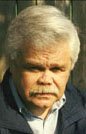
"All border towns bring out the worst in a country." Miguel "Mike" Vargas
In 1957 Universal Studios sent Orson Welles a script based loosely on Whit Masterson's* Badge of Evil, asking if he'd play the part of the crooked detective. According to Welles, the script was a very bad one, with not much in it other than a detective with a good record who plants evidence because he knows somebody is guilty -- and the fellow turns out to be really guilty. But Welles needed the money and agreed to do it. Universal then called up Charlton Heston who at the time was coming off the success of The Ten Commandments, and told him "Here's a script -- we'd like you to read it. We have Welles." Heston misunderstood and responded, "Well, any picture that Welles directs, I'll make." Universal, instead of correcting this misunderstanding, asked Welles if he'd direct. Welles agreed under the condition that he could rewrite the script. Universal let him do it, but would only pay him his original salary as an actor ($125,000) and not as a director or writer. And so was born Touch of Evil, which along with The Third Man, was arguably one of the greatest film noir movies from the 50s.
The opening sequence is the most famous in the movie: a three minute and twenty second uninterrupted crane tracking shot that follows a shadowy figure placing a bomb in a car and then an unsuspecting couple -- a wealthy American businessman and his stripper girlfriend -- entering the car and driving towards the US-Mexican border four blocks away, all the while (due to traffic, donkeys in the street, etc.) keeping pace with Miguel and Susan Vargas (Charlton Heston and Janet Leigh), newlyweds who are heading to the US side of the border in search of a chocolate soda. It isn't until the car enters the US side of the border that the car separates from Vargas and his wife and explodes into a deadly fireball.
While the bomb was planted on Mexican soil (a fictitious town called Los Robles which was patterned after Tijuana), the explosion occurred in the US, and is to be investigated by US officials. Vargas, a top Mexico City narcotics investigator, hangs around to offer his assistance as the police wait for Hank Quinlan to arrive. Orson Welles was 42 when Touch of Evil was filmed, but with the makeup to make his face appear swollen and bloated, the padding under his ever present overcoat, the thick cane he relies on and the camera angles to make his heft appear far heavier, Welles' Quinlan is massive. A bloated monstrosity of a man who looks like he's in his late 60s (another hint of his age is his wife had been murdered -- strangled to death -- thirty years earlier, the killer being the only criminal to escape Quinlan's justice).
When Quinlan arrives at the scene he makes quick intuitive guesses as to what happened and what needs to be investigated. Quinlan is a man of intuition and expediency while Vargas is more of a technocrat, a by-the-numbers straight-laced cop. Quinlan leads an expedition to the Mexican side of the border, a tawdry area lined with bars, strip clubs and brothels. Quinlan and his fellow cops descend on the strip club where the dead stripper had worked, eager to catch glimpses of naked flesh inside. In an alley outside the club, Vargas is attacked by one of the Grandi gang members (a parallel story is one of the Grandi gang trying to intimidate Vargas to drop a case against their patriarch), who throws acid at Vargas's face. In Welles' original script, the acid misses Vargas and hits a cat asleep in the trash. This was changed in the film and the acid instead explodes in a smoky hiss against the poster of the dead stripper.
As Quinlan leaves the back entrance of the Rancho Grande strip club, he is stopped by pianola music coming from a local brothel run by Marlene Dietrich (Universal Studios was later surprised and delighted to learn that Dietrich was in the film. They ended up paying her so they could give her billing, but she had been willing to be in it unbilled as a favor to Welles). Dietrich's brothel is a place of another era, complete with its pianola, mounted bull's head on the wall, and other aging artifacts. It's a place that Hemingway might've been comfortable in. Or Welles. As it is, it has been years since Quinlan had visited Tanya's (Marlene Dietrich) brothel, and at first she doesn't recognize him. When Quinlan wistfully identifies himself, Tanya prophetically warns him that he should lay off the candy bars. Even under all the padding and with camera angles to accentuate Quinlan's bulk, Welles was still a large man when he made Touch Evil (although he was going to get much larger) and he should've heeded that warning.
While Vargas is aiding in the investigation, Quinlan's partner Pete Menzies (played touchingly by Joseph Calleia) drives Susan Vargas to the Mirador Motel for protection against the Grandi gang (although, as it turns out the motel is owned by the Grandis) and to wait for her husband. The motel is both isolated and seedy, and the night clerk is played brilliantly by Dennis Weaver. Weaver's night clerk is a mass of spasms, twitches and leers. Someone who can barely make eye contact and jumps when Susan Vargas asks if he can make the bed, barking out the single question "Bed?" in return as if it were something fearsome and unholy. One can only wonder if watching Touch of Evil gave Hitchcock the idea of putting Janet Leigh in yet another bad motel setting. Quinlan's intuition leads him to suspect the dead man's daughter's boyfriend, a Mexican shoe clerk named Manolo Sanchez. Quinlan brings his fellow cops and prosecutors to Sanchez's claustrophobic shoebox-sized apartment, and then performs his sleight-of-hand -- hiding sticks of dynamite in a box so his unsuspecting partner will find them. As Quinlan waits for the dynamite to be discovered, he's an entertainer, amused by his own trickery. The problem though is the magic trick has been revealed -- Vargas had used the bathroom and knocked over the box where Quinlan later had planted the dynamite. He knows the box had been empty. He knows what Quinlan has done. The great magician has been exposed as a fake -- and Quinlan's reputation is in jeopardy of being destroyed. Quinlan is a corrupt cop but his motivation is because he knows he is greater than those mere mortals around him. He is doing nothing more than speeding up the convictions of the guilty. He doesn't financially profit from his corruption. In fact, later he demands from his partner, what has he got in life, a few acres and a turkey ranch? Critic Andre Bazin describes Quinlan as such:
Quinlan is physically monstrous, but is he morally monstrous? The answer is yes and no. Yes, because he is guilty of committing a crime to defend himself; no because from a higher moral standpoint , he is, at least in certain respects, above the honest, just, intelligent Vargas, who will always lack the sense of life which I call Shakespearean. These exceptional beings should not be judged by ordinary laws. They are both weaker and stronger than others. Weaker... [but] also so much stronger because directly in touch with the true nature of things, or perhaps one should say, with God.Facing exposure and ruin, Quinlan enters an agreement with "Uncle" Joe Grandi, the new head of the Grandi organization. Joe Grandi, as played by Akim Tamiroff, is a wannabe Edward G. Robinson-type gangster, but is only comical and pathetic. An earlier scene has him running around with his toupee half off. Uncle Joe's plan is to frame Susan Vargas on trumped drug charges -- back at the Mirador Motel his gang had invaded Susan's room with a butched-up Mercedes McCambridge begging to be able to watch as gang members grab Susan's legs as she's dolled out in a negligee. Quinlan is now drinking for the first time in years, waiting until the last moment to go along with Uncle Joe's plans (in fact calling up headquarters at the last possible moment to see if Sanchez has confessed yet -- he may have framed him, but he intuitively knows the man is guilty). When Quinlan finally enters the cheap downtown hotel room where Grandi had Susan brought , she is in bed, unconscious, with reefers and heroin needles scattered about the room (as a concession to the times and the censors, she had been drugged with sodium pentothal - with nothing else done to her. Come on! Sodium pentothal? In real life, she would've been shot up with heroin, and each of the gang members -- including Mercedes McCambridge would've had a turn with her!). Quinlan has other plans -- namely to strangle Uncle Joe and leave his body with Susan. Quinlan's actual murder of Uncle Joe is a gruesome, violent scene, intentionally sexually charged. As Welles said in conversations with Peter Bogdanovich** "It was perverse and morbid... one of those go-as-far-as-you-can-go--in that kind of dirty department... when [Tamiroff] looked at the gun, it was every cock in the world. It was awful, the way he looked at it--made the whole scene possible." Make no mistake about it, this is an ugly scene. Tamiroff is a much smaller man than Welles, and is just about consumed by Welles. Tamiroff's character is dragged around the room, his shirt torn at the chest, his toupee knocked off. Eventually Quinlan strangles him with one of Susan's stockings, leaving Uncle Joe's face hanging over the bed, eyes bulging out by a nice effect of using painted contact lenses. Welles wanted the shot of the bulging eyes short enough so it would be almost subliminal -- something people wouldn't be quite sure they saw -- but the studio added extra frames to that shot. More on that later. When Quinlan leaves the room a close up of a sign on the door reads:
Stop, Forget Anything, Leave Key at Desk.After Quinlan leaves, Susan Vargas wakes up from her sodium pentothal-induced stupor to see Uncle Joe's dead bulging eyes staring at her and she runs screaming to the balcony. Later, after she's been arrested, Pete Menzies confronts Vargas. Quinlan had forgotten something in the hotel room. His cane. And Menzies had found it. He can no longer ignore the fact that he's been an unwitting dupe in framing scores of criminals (probably all guilty). He agrees to help Vargas uncover the truth about Quinlan by wearing a recording device. After the murder, Quinlan had holed up at Tanya's brothel. Drunk, he asks her to read his fortune. She tells him he has no future, it's been used up. Menzies later lures Quinlan out of the brothel so he can coax a confession out of him. Quinlan leads Menzies along a desolated area along the canal and oil derricks, while Vargas has to climb mountains of trash and wade through filth to try to record Quinlan's guilt. Eventually Quinlan incriminates himself, but with Vargas and his recording equipment under a bridge, an echo can be heard of Quinlan's voice, leading Quinlan to realize the level of betrayal. Quinlan shoots Menzies and then tries to kill Vargas before being shot by his dying partner. After Quinlan is shot he tells his partner that's the second bullet he's taken for him. For years that line puzzled viewers. The reason for that was in Welles original version, Menzies had earlier told Susan Vargas how Quinlan had taken a bullet for him -- saved his life, but left Quinlan with his limp and needing his cane. The studio edited version had cut the scene, and it wasn't until the 1998 version was released that the scene was re-added and Quinlan's last mocking line made sense. After being shot, Quinlan falls backward into the canal and the filth where he dies. Tanya arrives at the scene with the DA (who announces that Sanchez confessed to the crime after all) and provides as a eulogy to Quinlan: He was some kind of a man. What does it matter what you say about people?
Welles on Quinlan's betrayal***:
Quinlan is [Menzies's] God. And as Menzies adores him, the real theme of the script is betrayal; the terrible necessity for Menzies to betray his friend. And that's where there is ambiguity, because I don't know whether he should have betrayed him or not. No, I really don't know. I force Menzies to betray him, but the decision does not come from him, and frankly, in his place, I would not have done it!While Welles was making Touch of Evil he was under the impression that he was going to be making more movies for Universal, that Touch of Evil was going to be his entry back into Hollywood. When the studio saw his final cut version, he was fired as director and barred from the lot. Touch of Evil is a wonderfully dark movie, but for 1958, it was probably too dark and too strange for Hollywood, and it hit on difficult themes: police corruption, racism and drugs. The studio must have felt as betrayed by Welles as he did by the studio. While Welles would make other films, notably Chimes at Midnight, The Trial and F is for Fake (along with a slew of half-finished films), this would be Welles last hollywood film. And as a final act of betrayal, the studio re-edited Touch of Evil. Welles would later write a 56-page memo requesting changes back to his original film, which the studio ignored (the 1998 version attempted to restore movie according to Welles memo). Funny how art mirrors life.
* Whit Masterson was a pseudonym for Wade Miller -- aka Robert Wade and William Miller.
** From This Is Orson Welles by Orson Welles and Peter Bogdanovich
*** From Orson Welles Interviews edited by Mark W. Estrin
I originally wrote this essay in 2006 for the Borderland Noir issue of Hardluck Stories edited by Craig McDonald.
 My book is being featured on Saturday February 22nd 2014 at eBookSoda, a new readers' site where they'll send you ebook recommendations tailored to your taste.www.ebooksoda.com.